

















May
Quick Answer
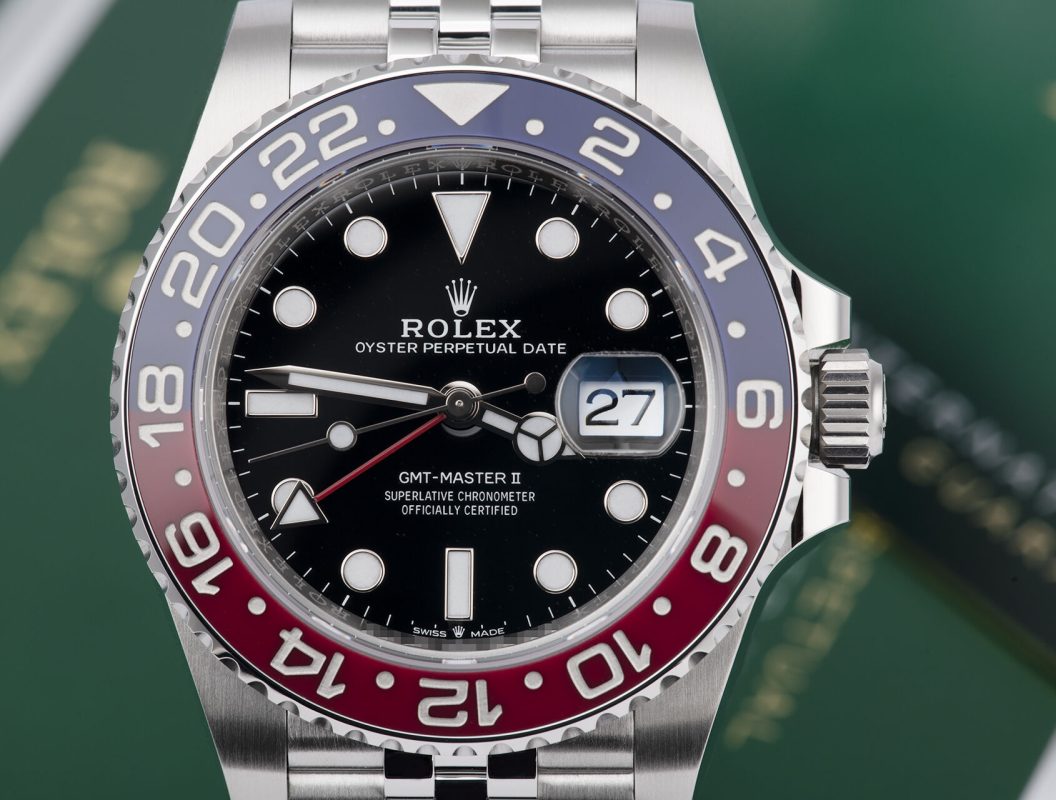
At Watches and Wonders 2026, Rolex officially removed every GMT-Master II “Pepsi” reference from its active catalog, including the steel 126710BLRO and the white gold 126719BLRO. The reaction was immediate: secondary market prices climbed well above pre-discontinuation levels, listings tightened, and collectors started repositioning around the remaining colorways. If you were already considering a Pepsi, the decision window has narrowed and the math has changed.
Compare current GMT-Master II inventory before the next price move.
What Happened: The Pepsi Was Quietly Retired
Rolex did not stage a farewell tour for the Pepsi. The reference simply did not appear in the new 2026 catalog. Within hours, the watch community confirmed what the absence implied: the red-and-blue bezel GMT-Master II is no longer in current production.
Two references took the hit:
- 126710BLRO — stainless steel Oyster, the most recognizable modern Pepsi
- 126719BLRO — 18k white gold version on Oyster bracelet
For the first time in years, the red-and-blue Cerachrom bezel is missing from the active Rolex lineup. The Pepsi is not just rare now. It is closed.
Why the Discontinuation Hit So Hard
The Pepsi is not a niche reference. It sits at the intersection of three powerful collector themes at once:
- aviation heritage tied to the original 1950s GMT program
- the ceramic-bezel modernization that defined the 2010s sports Rolex era
- a color combination that is instantly readable across a room and across a generation
That is why this discontinuation is being treated differently from a routine catalog cycling. Buyers are not reacting to a niche reference disappearing. They are reacting to one of the most culturally loaded sports Rolexes losing its production status entirely.
There is also a supply story underneath the cultural one. Producing a two-color ceramic bezel — especially the red half — is genuinely difficult. Rolex’s own technical constraints kept Pepsi allocations tight long before the discontinuation. Closing the reference does not reverse those constraints. It locks them in.
For buyers who do not want to chase the post-discontinuation premium, the black-and-blue Batman 126710BLNR is the most direct alternative inside the same case generation, and the broader GMT-Master II catalog shows what is still actively available.

The Immediate Secondary Market Reaction
The market did exactly what the market does when a hyped reference closes:
- prices jumped fast on listing platforms and dealer inventories
- unworn examples were pulled and repriced
- waitlist frustration converted into secondary-market urgency
- speculators piled in because the headline was simple
For now, the Pepsi is trading well above its pre-discontinuation premium. That spread will not stay constant. Some of it is real scarcity repricing. Some of it is short-term reaction. The job for a serious buyer is to separate the two.
If you are pricing a Pepsi this week, you are not buying the steady-state market. You are buying inside the spike.
Get a clean reading on what your watch is worth in the post-discontinuation market.
What’s Left in the GMT-Master II Lineup
The GMT-Master II is not gone. The Pepsi is gone. The rest of the family is still very much active and now carries more weight in Rolex’s travel-watch story.
Still in production:
- Batman — black-and-blue Cerachrom bezel, on Oyster or Jubilee
- Sprite — green-and-black bezel, left-handed crown configuration
- Black-grey — the more discreet daily-wear option
- Two-tone and gold variants — including rose gold and white gold non-Pepsi configurations
The practical effect is that demand pressure that used to land on the Pepsi is now redistributing. Batman and Sprite become the natural fallback choices for buyers who wanted Pepsi visibility but cannot or will not pay the post-discontinuation premium.
How to Think About a Pepsi Right Now
Buying a Pepsi inside the post-discontinuation spike is not the same as buying one a year ago. The decision changes shape.
It still makes sense if:
- you specifically want the Pepsi, not just any GMT-Master II
- you are comfortable with the current premium and treat the watch as a long-term hold
- the example is strong: full set, clean condition, original bracelet, verifiable history
- you understand you are buying into a closed-supply story, not an active-production one
It does not make sense if:
- you are stretching financially because of the headline
- you only want the most-talked-about watch in the room
- the seller cannot back the asking price with the actual quality of the watch
- you are treating it as a short-term flip — the spike is already priced in
The reference does not protect you from overpaying. The specific watch does.

Short-Term vs Long-Term Outlook
Short term. Expect continued upward pressure as long as supply stays tight and the discontinuation is fresh in the news cycle. Premium examples — full set, low wear, original components — will move first and command the strongest prices.
Long term. History on previous Rolex discontinuations (5513, 16710, 116520 Daytona, etc.) suggests a pattern: an early spike, a partial cooldown, then a sustained premium above pre-discontinuation baseline. The Pepsi has the cultural weight to follow that curve. It does not guarantee it. Condition, originality, and reference-specific demand still decide the outcome on any individual watch.
This is why authentication and verification matter more, not less, after a discontinuation. The premium attracts both real buyers and bad actors.
Verify originality and condition before paying a post-discontinuation premium.
What Serious Buyers Are Checking Right Now
Beyond the headline, the actual buying checklist on a 126710BLRO or 126719BLRO has not changed. It just matters more:
- exact reference and production year
- box, papers, and full set status
- service history and last service date
- bracelet stretch, end-link fit, and clasp condition
- bezel insert color match (red half is a known production-variation point)
- caseback, lug, and case-edge sharpness — Pepsis are often polished hard
- whether the seller is pricing off real, current comps or off peak-week fantasy
A Pepsi that ticks every one of those boxes is genuinely scarce. A Pepsi that does not is just an expensive watch with a famous bezel.
Final Take
The 2026 Pepsi discontinuation is the kind of moment that resets a category. It reshuffles which references carry the demand, it pushes the Batman and Sprite into a more central role, and it turns every existing 126710BLRO and 126719BLRO into part of a permanently closed pool.
For buyers, the right move is not panic and not paralysis. It is selectivity. The Pepsi story is real. The premium is real. The risk of overpaying for a weak example inside a hot market is also real. Buy the watch, verify the watch, and let the headline take care of itself.
If you are selling a Pepsi or repositioning a GMT-Master II, get a current-market offer.
Frequently Asked Questions
Yes. Rolex removed every Pepsi GMT-Master II reference from its active catalog at Watches and Wonders 2026. There is no current-production red-and-blue bezel GMT-Master II in the lineup.
Both the stainless steel 126710BLRO and the white gold 126719BLRO are no longer in production. Earlier Pepsi references (such as 116719BLRO and the 16710 family) were already out of production before this round.
Prices spiked quickly across major resale channels. Unworn and full-set examples saw the sharpest moves, while inventory across dealers and private listings tightened as sellers repriced or pulled their watches.
Yes. The Batman (black-blue), Sprite (green-black, left-handed crown), grey-black, and several precious-metal non-Pepsi configurations remain in current production. They are now carrying more of the demand that used to flow into the Pepsi.
Only if you specifically want that watch and the example in front of you justifies the price on its own merits. Buying inside a discontinuation spike is fine when the watch is right and you plan to keep it. It is a trap when you are reacting to a headline.
Short term, the trend is upward as long as supply stays tight and the news is fresh. Long term, historical patterns suggest a partial cooldown followed by a sustained premium — but only on examples with the condition and provenance to back it up.
 Free Shipping for all orders