

















A. Lange & Söhne, Blog
The Ultimate A. Lange & Söhne Buyer’s Guide: Lange 1, Datograph & Zeitwerk Investment Analysis
Aug
Quick Answer: A. Lange & Söhne represents the absolute pinnacle of finishing, defined by untreated German silver ¾ plates, double assembly, and uniquely hand-engraved balance cocks. For 2026, their strictly limited production guarantees exceptional secondary market stability, making them the premier investment alternative to the traditional Swiss Holy Trinity.
Welcome to the definitive collector’s manual, presented by Luxury Watches USA. For American collectors seeking to elevate their portfolios beyond the predictable Swiss mainstays, Glashütte’s crown jewel offers an uncompromising alternative. This guide unpacks the horological mastery, historical weight, and 2026 investment trajectory of A. Lange & Söhne’s most critical pillars: the Lange 1, the Datograph, the Zeitwerk, and the Saxonia/1815 families.
The German Horology Standard: Glashütte Heritage and Haute Horlogerie
To understand A. Lange & Söhne is to understand a narrative of resurrection. Founded in 1845 by Ferdinand Adolph Lange, the brand established the town of Glashütte in Saxony as the epicenter of German watchmaking. However, following World War II and the subsequent Soviet occupation, the company was nationalized, its legendary name practically erased from global horology for nearly fifty years.
It wasn’t until 1990, immediately following the fall of the Berlin Wall, that Walter Lange (great-grandson of the founder) and horological visionary Günter Blümlein resurrected the brand. When they unveiled their first four watches in 1994, they didn’t just re-enter the market; they issued a direct challenge to the Swiss establishment, establishing what we now recognize as the ultimate “German Horology Standard.”
The Hallmarks of Lange Finishing
While a Patek Philippe Calatrava
represents the height of Swiss tradition, A. Lange & Söhne employs a strictly German architectural and decorative language that many collectors argue surpasses the Swiss Holy Trinity
in pure finishing.
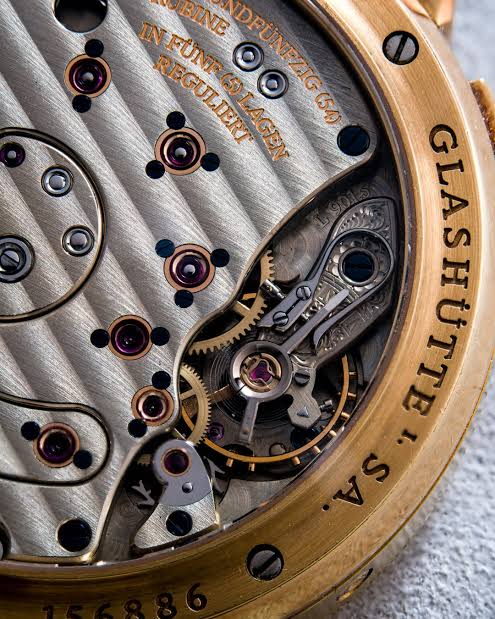
Untreated German Silver (Maillechort)
Unlike Swiss movements that traditionally use rhodium-plated brass, Lange constructs its base plates and bridges from untreated German silver—an alloy of copper, nickel, and zinc. Over time, this metal oxidizes to develop a warm, honey-gold patina that is entirely unique to the wearer’s environment and the watch’s age. Because the metal is highly sensitive to oils, watchmakers must wear finger cots and handle the components with agonizing care to prevent permanent tarnishing during assembly.
The ¾ Plate Construction
A signature introduced by F.A. Lange in 1864, the three-quarter plate covers most of the movement’s geartrain, providing immense stability and shock resistance compared to traditional individual Swiss bridges. While it makes the movement incredibly robust, it drastically increases the difficulty of assembly, as the watchmaker must align all the gear pivots simultaneously when lowering the plate.
The Hand-Engraved Balance Cock
Every A. Lange & Söhne timepiece features a balance cock that is engraved entirely by hand. The floral motif is cut freehand by one of the brand’s master engravers. Because each engraver has a unique pressure, style, and depth of cut, an experienced collector can often identify exactly which artisan at the Glashütte manufacture engraved a specific watch just by looking at the balance cock through a loupe.
Gold Chatons and Blued Screws
Instead of pressing synthetic rubies directly into the plate, Lange mounts its bearing jewels in solid gold chatons. These chatons are then secured to the three-quarter plate using thermally blued steel screws—a labor-intensive aesthetic nod to 19th-century pocket watches that provides a striking visual contrast against the warm German silver.
The Double Assembly Process
Every single A. Lange & Söhne watch, from an entry-level Saxonia to a Grand Complication, is assembled not once, but twice. The movement is fully assembled, adjusted, and tested using temporary screws. Once it meets the brand’s chronometric standards, it is completely disassembled. The components are then cleaned, receive their final polishing and finishing, and are reassembled by the same watchmaker using pristine, brand-new blued screws. This ensures that the delicate finishing is never marred by the grueling regulation and testing phases.
In-Depth Model Breakdown: The Pillars of A. Lange & Söhne
For the US luxury watch collector, understanding the nuances between references, calibres, and eras is paramount. Here is a granular analysis of the core collections that define the brand.
1. The Lange 1 (Ref. 191.032, 101.032)
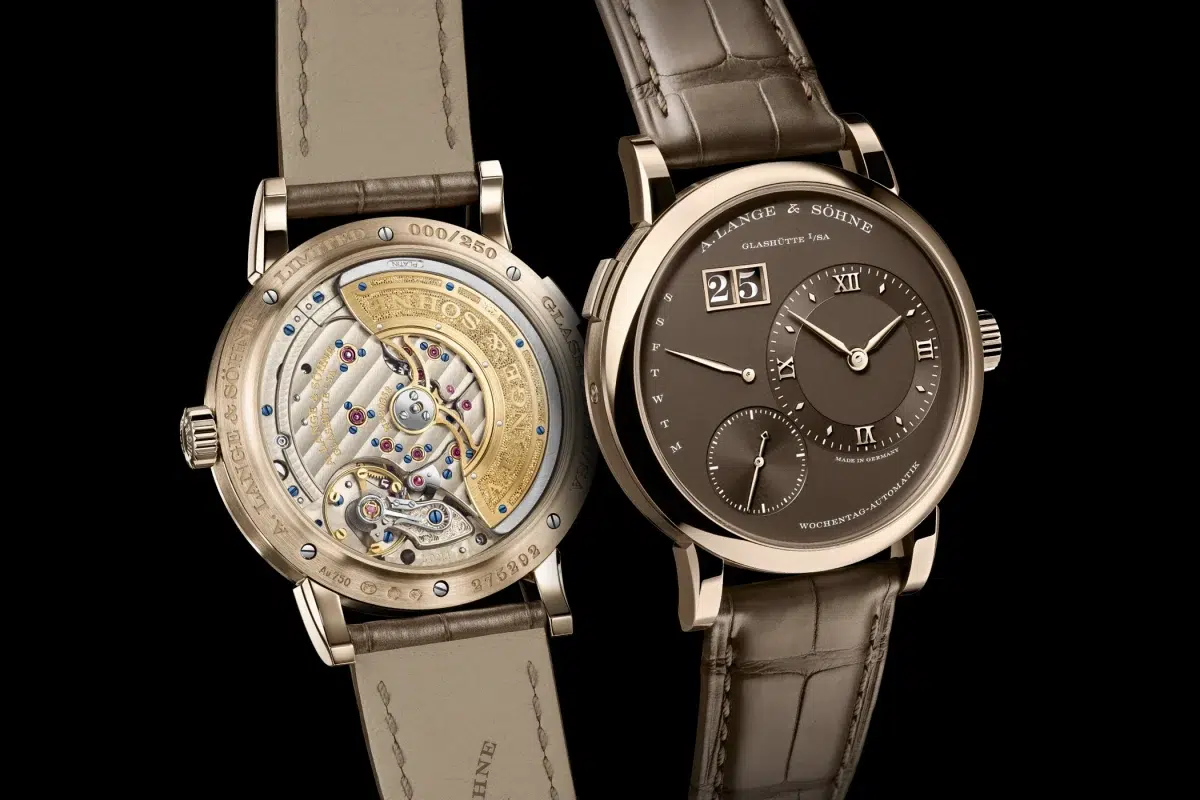
The Lange 1 is the undisputed face of modern German watchmaking. Unveiled in 1994, it shattered traditional design conventions and immediately established A. Lange & Söhne’s contemporary identity.
The Golden Ratio and Asymmetric Design
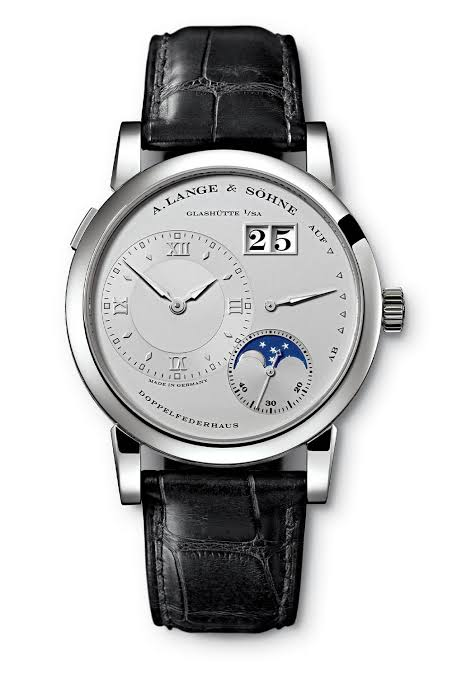
The dial of the Lange 1 appears avant-garde but is deeply rooted in classical mathematics. The layout is strictly governed by the Golden Ratio and the rule of non-overlapping displays. The centers of the main time dial, the seconds sub-dial, and the outsize date form an exact isosceles triangle. No hand ever crosses another dial, ensuring perfect legibility at all times.
The Outsize Date (Großdatum)
Inspired by the five-minute clock in Dresden’s Semper Opera House (which F.A. Lange’s mentor, Johann Christian Friedrich Gutkaes, built), the outsize date uses two separate discs—a cross for the tens and a standard disc for the units—to display the date at a size roughly three times larger than a conventional date window. It is framed by a solid gold window that matches the case material.
Calibre Evolution: L901.0 vs. L121.1
- Ref. 101.032 (First Generation): Powered by the Calibre L901.0, this model utilized twin mainspring barrels to achieve a 72-hour power reserve. The movement featured a solid ¾ plate with island bridges that gave it a highly architectural look.
- Ref. 191.032 (Second Generation): Introduced in 2015, the updated Calibre L121.1 kept the exact dial proportions but drastically improved the mechanics. The outsize date now jumps precisely at midnight rather than slowly rolling over, and the seconds hand resets to zero when the power reserve is exhausted. The new movement architecture also features a larger, free-sprung balance wheel and an entirely redesigned ¾ plate that exposes more of the geartrain.
Key Variations: The Lange 1 family has expanded to include the Lange 1 Moon Phase (which uniquely combines the moon phase with a day/night indicator on a solid gold disc) and the Lange 1 Time Zone, heavily favored by international collectors for its intuitive dual-time and city ring display.
2. The Datograph (Ref. 405.035 “Up/Down”)
If the Lange 1 announced the brand’s return, the Datograph established its absolute supremacy. Introduced in 1999, the Datograph sent shockwaves through Switzerland. At the time, even Patek Philippe and Vacheron Constantin were relying on heavily modified, outsourced ebauches (primarily from Lemania) for their chronographs. Lange, an upstart brand, built a fully in-house, exquisitely finished, integrated chronograph from the ground up.
Legendary independent watchmaker Philippe Dufour famously purchased a Datograph with his own money, publicly declaring the Calibre L951.1 to be the greatest chronograph movement ever made.
Mechanical Innovations
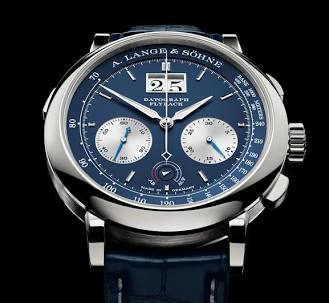
The Datograph is not just a standard chronograph; it is a Flyback Chronograph with a precisely jumping minute counter.
- Flyback Mechanism: Allows the user to stop, reset, and restart the chronograph with a single push of the lower button, historically designed for aviation navigation.
- Precisely Jumping Minute Counter: Unlike conventional chronographs where the minute hand slowly creeps forward, the Datograph’s minute hand jumps instantaneously the exact fraction of a second the sweeping seconds hand crosses 60. This requires a highly complex and energy-intensive operating lever.
Ref. 405.035 (The Up/Down)
In 2012, Lange updated the Datograph to the “Up/Down” (Auf/Ab) reference. The case size was subtly increased from 39mm to 41mm to suit modern tastes. Crucially, the power reserve was extended from 36 to 60 hours, and a power reserve indicator was added at the 6 o’clock position. The movement (now Calibre L951.6) lost none of its three-dimensional, architectural depth. Turning a Datograph over reveals a micro-city of steel levers, gold chatons, and German silver plates, finished with a mix of straight graining, perlage, and anglage that defies mass production.
3. The Zeitwerk (Ref. 142.028)
Introduced in 2009, the Zeitwerk is arguably the most audacious mechanical watch of the 21st century. It takes the concept of a digital display and executes it using pure, traditional mechanical horology.
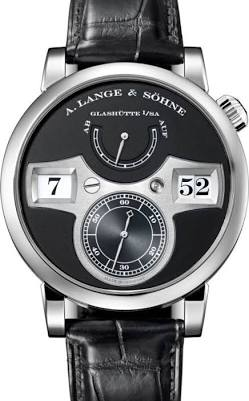
The Digital-Mechanical Paradigm
The Zeitwerk displays the time from left to right in a digital format (e.g., “10” and “52”) using massive rotating discs. These discs are framed by a striking “time bridge” made of solid German silver that penetrates the dial itself, anchoring the complex mechanics beneath.
The Constant-Force Escapement (Remontoire)
The engineering challenge of the Zeitwerk is immense. Moving three heavy discs (one for hours, two for minutes) simultaneously requires a massive surge of torque. If powered directly by the mainspring, this surge would severely disrupt the balance wheel’s amplitude, ruining the watch’s accuracy.
To solve this, Lange engineered a patented constant-force escapement. This mechanism sits between the mainspring barrel and the balance. Once every minute, it releases a precise, controlled burst of energy to advance the discs instantaneously, while simultaneously delivering a perfectly even flow of power to the escapement. This ensures the watch runs with chronometric precision from the first hour of power to the last.
Ref. 142.028
The modern iterations of the Zeitwerk have refined this movement (Calibre L043.6), doubling the power reserve to 72 hours—an astonishing feat given the energy required to jump the digital discs thousands of times over three days. For collectors who appreciate disruptive engineering paired with traditional hand-finishing, the Zeitwerk sits in a class entirely of its own.
4. Saxonia & 1815: Understated Elegance
For collectors looking to enter the A. Lange & Söhne ecosystem, or those who prefer the “stealth wealth” aesthetic of an ultra-thin dress watch, the Saxonia and 1815 lines represent the foundation of German luxury.
- The Saxonia: Named after the state of Saxony, this collection focuses on absolute minimalism and structural clarity. The Saxonia Thin, powered by the remarkably slim Calibre L093.1, offers exactly what a dress watch should: applied solid gold baton indices, perfectly proportioned alpha hands, and zero unnecessary clutter. Despite its entry-level positioning, the movement receives the exact same standard of finishing, double assembly, and engraved balance cock as a million-dollar Tourbillon.
- The 1815: A tribute to Ferdinand Adolph Lange’s birth year, the 1815 family utilizes traditional design cues from historical pocket watches. It features Arabic numerals, a railway-track minute scale, and blued steel hands. The 1815 Chronograph is heavily sought after by collectors who want the phenomenal movement architecture of the Datograph without the bulk or aesthetic weight of the outsize date.
Investment & Grey Market Value Analysis for 2026
As we analyze the luxury watch market in 2026, the data for A. Lange & Söhne tells a compelling story of resilience, scarcity, and sophisticated demand. The explosive, often volatile hype cycles that have characterized certain steel sports models from Geneva have largely bypassed Glashütte. Instead, Lange has cultivated a trajectory of steady, mature appreciation.
The Power of Extreme Scarcity
The bedrock of A. Lange & Söhne’s investment thesis is production volume. While Patek Philippe produces roughly 60,000 to 70,000 watches annually, and Audemars Piguet produces around 50,000, A. Lange & Söhne’s annual production is estimated to be rigidly capped at under 5,000 timepieces per year.
The bottleneck is not marketing or demand; it is the physical limitation of their double assembly process and the finite number of master artisans capable of executing their finishing standards. In 2026, as global wealth expands and the pool of educated collectors deepens, this hard supply cap creates a powerful floor for secondary market prices.
The 2026 Market Outlook
- Lange 1: The Lange 1 remains a blue-chip asset. Early generation references (like the 101.027X or closed caseback models) are achieving significant premiums at auction as neo-vintage collecting booms. Modern references (191.032 in pink gold) hold extremely close to retail on the grey market, with waitlists at boutiques stretching well over 18-24 months.
- Datograph: The Datograph Up/Down has transitioned from a cult classic to a consensus “grail” watch. Because chronographs are universally understood by collectors, the sheer superiority of the L951.6 calibre makes the Datograph a primary target for wealth diversifying out of standard Swiss pieces. Platinum models are seeing steady 5-8% annualized growth on the secondary market.
- Zeitwerk: The Zeitwerk caters to a highly specific, ultra-wealthy demographic. Because it has no direct comparison in the market (unlike a standard perpetual calendar or chronograph), its value retention is robust. Discontinued variations, such as the Zeitwerk Luminous or Handwerkskunst editions, routinely trade at massive premiums due to their extreme rarity (often limited to 30-100 pieces globally).
- Saxonia & 1815: These models represent the strongest value proposition in high horology today. While they may not appreciate as aggressively as a Datograph, purchasing a pre-owned Saxonia allows a collector to acquire Holy Trinity-beating finishing at a fraction of the cost, with minimal downside risk.
The “Stealth Wealth” Shift
In 2026, security concerns and a cultural shift away from ostentatious displays of wealth have driven collectors toward “stealth wealth.” A platinum Datograph or a white gold Lange 1 is practically invisible to the untrained eye, easily mistaken for a simple steel watch by the general public. To those who know, however, it signals a profound, educated appreciation for horology. This psychological shift is a major tailwind for Lange’s market performance.
What US Buyers Must Check: Authentication & Completeness
When acquiring an A. Lange & Söhne on the secondary or grey market, the stakes are incredibly high. A poorly maintained piece can result in service bills exceeding $10,000. At Luxury Watches USA, our watchmakers enforce a rigorous checklist before certifying any Lange. Here is what you must know:
1. The Condition of the German Silver (Patina vs. Damage)
Untreated German silver develops a natural, warm yellow patina over time. This is desirable. However, if a previous watchmaker touched the plates without finger cots, the oils from their skin will leave permanent, dark fingerprint stains etched into the metal. The only way to fix this is a complete replacement of the ¾ plate by the factory in Glashütte—an incredibly costly endeavor. Always inspect the movement through a high-powered loupe under harsh light.
2. Case Materials and Hallmarks
A. Lange & Söhne does not make standard production watches in stainless steel (with the sole, exceedingly rare exception of the Odysseus and a handful of mythic early Lange 1s). Cases are crafted exclusively in 18k Pink Gold, 18k Yellow Gold, 18k White Gold, Platinum, and occasionally Honeygold (a proprietary, harder gold alloy used in limited editions).
- Platinum vs. White Gold: To tell the difference quickly without a scale, check the hallmarks under the lugs. Platinum will carry the PT950 mark, while White Gold will have the Au750 mark. Furthermore, Lange often uses blued steel hands on white gold models, and rhodiumed gold hands on platinum models.
3. Clasps and Buckles
Pay close attention to the strap hardware. A standard tang buckle is excellent, but Lange’s solid gold or platinum double-fold deployant clasps retail for thousands of dollars on their own. Unscrupulous sellers sometimes swap deployant clasps for standard tang buckles before selling the watch to maximize their profit. Ensure the hardware matches the original reference specifications.
4. Box, Papers, and the “Proof of Origin”
A complete set is critical for investment value. Lange’s modern presentation boxes are luxurious, heavy leather constructs. However, collectors must be aware that older Lange boxes from the 1990s and 2000s were made with a type of synthetic leather interior that inevitably degrades, becomes sticky, and flakes apart over time. This degradation is normal for the era and authentic; ironically, a pristine 1998 box is a red flag.
More importantly, ensure the warranty booklet matches the case and movement numbers. If the original papers are lost, the watch should ideally be accompanied by an official “Proof of Origin” document ordered from the Glashütte archives.
Ready to Elevate Your Collection?
Transitioning from mainstream luxury to independent haute horlogerie requires a trusted partner. At Luxury Watches USA, every A. Lange & Söhne in our inventory undergoes a rigorous, multi-point inspection by master watchmakers to guarantee absolute authenticity, mechanical perfection, and aesthetic integrity.
Whether you are seeking the architectural perfection of a pre-owned Lange 1, hunting for a discontinued Zeitwerk, or wish to sell a piece from your portfolio, our specialized German horology team is at your disposal.
- [Explore Our Certified Pre-Owned A. Lange & Söhne Collection]
- [Request a Specific Reference Sourcing]
Frequently Asked Questions (FAQ)
Is A. Lange & Söhne better than Patek Philippe?
“Better” is subjective, but A. Lange & Söhne undeniably offers superior, more labor-intensive movement finishing on their entry-level and mid-tier watches compared to Patek Philippe. Lange uses highly decorated German silver and double-assembles every watch, whereas Patek relies heavily on rhodium-plated brass and only applies top-tier hand finishing to their Grand Complications. Patek, however, retains an edge in ultra-thin calibres and brand recognition.
Why does A. Lange & Söhne use a ¾ plate?
The three-quarter plate was introduced by founder Ferdinand Adolph Lange in 1864 to improve movement stability. By covering all the wheels of the going train (except the escape wheel) with a single, massive bridge, the movement becomes highly resistant to dust and mechanical shocks. It also provides a beautiful, expansive canvas for traditional Glashütte ribbing (striping).
Do A. Lange & Söhne watches hold their value?
Yes. Because production is strictly limited to fewer than 5,000 pieces globally per year, demand vastly outstrips supply for core models. While they do not experience the aggressive hype bubbles of certain steel sports watches, models like the Lange 1, Datograph, and Zeitwerk demonstrate excellent long-term price stability and steady appreciation on the secondary market.
What is the A. Lange & Söhne double assembly process?
Every A. Lange & Söhne watch is assembled twice. First, the raw components are assembled, adjusted, and tested to ensure the watch functions perfectly. The watch is then completely taken apart, cleaned, and the final hand-finishing (like polishing and engraving) is applied. It is then reassembled with brand new blued screws. This guarantees the delicate finishing is not damaged during the regulation process.
Can I wear a Lange 1 or Datograph every day?
While A. Lange & Söhne timepieces are mechanically robust thanks to the ¾ plate design, they are ultimately precious metal dress and high-complication watches. They are well-suited for daily office or formal wear, but they are not sports watches. They should be kept away from heavy impacts, extreme magnetic fields, and water (most have only 30m of water resistance).
 Free Shipping for all orders