

















Sep
Omega’s Three Pillars: Which One Is Right for You?
Omega has been producing watches since 1848, but its cultural footprint is shaped by three collections that each dominate their respective categories: the Speedmaster that went to the Moon, the Seamaster that James Bond wears, and the Constellation that defined dress watch precision. If you’re considering an Omega — as a first watch, an addition to a collection, or an investment — this is where the decision gets made.

Speedmaster, Seamaster, or Constellation — not sure which fits your life? Our team has handled hundreds of each. Get a straight answer in 15 minutes.
A Brief History: Why Omega Sits at the Top Table
Founded in 1848, Omega achieved a series of milestones no other watchmaker can claim:
- 1932 — Official Olympic Games timekeeper, a role it still holds today
- 1965 — NASA selects the Speedmaster Professional for all manned space missions after testing 11 watchmakers; only Omega survives every test
- 1969 — The Speedmaster becomes the first watch worn on the Moon (Apollo 11)
- 1995 — The Seamaster Diver 300M becomes James Bond’s official watch, a role it’s held through every film since GoldenEye
These aren’t marketing stories — they’re documented historical records that underpin Omega’s brand permanence and resale value.
The Speedmaster — The Moonwatch
Launched in 1957 as a racing chronograph, the Speedmaster found its true calling in the space program. The hand-wound Caliber 1861 (and now the improved 3861) powers every Moonwatch — a movement so proven that NASA accepted it for all crewed missions without modification.
What you’re getting with the Speedmaster: – Manual-wind movement requiring daily winding — the ritual is part of the appeal – Tachymeter bezel engraved on the sapphire crystal (not on the bezel ring itself) – 300m water resistance on Professional models – An unbroken line of production since 1957 with clear reference documentation
The Omega Speedmaster Moonwatch retails around $6,700–$7,000 for the standard Professional. On the secondary market, well-preserved examples with boxes and papers trade close to retail, while vintage pre-Moon references start at $8,000–$25,000+ depending on caliber and condition.
Investment angle: Read our full breakdown of investing in Omega's Speedmaster before buying.
From the standard Moonwatch to rare vintage pre-Moon references — see what's in stock right now.
The Seamaster — The Diver and the Bond Watch
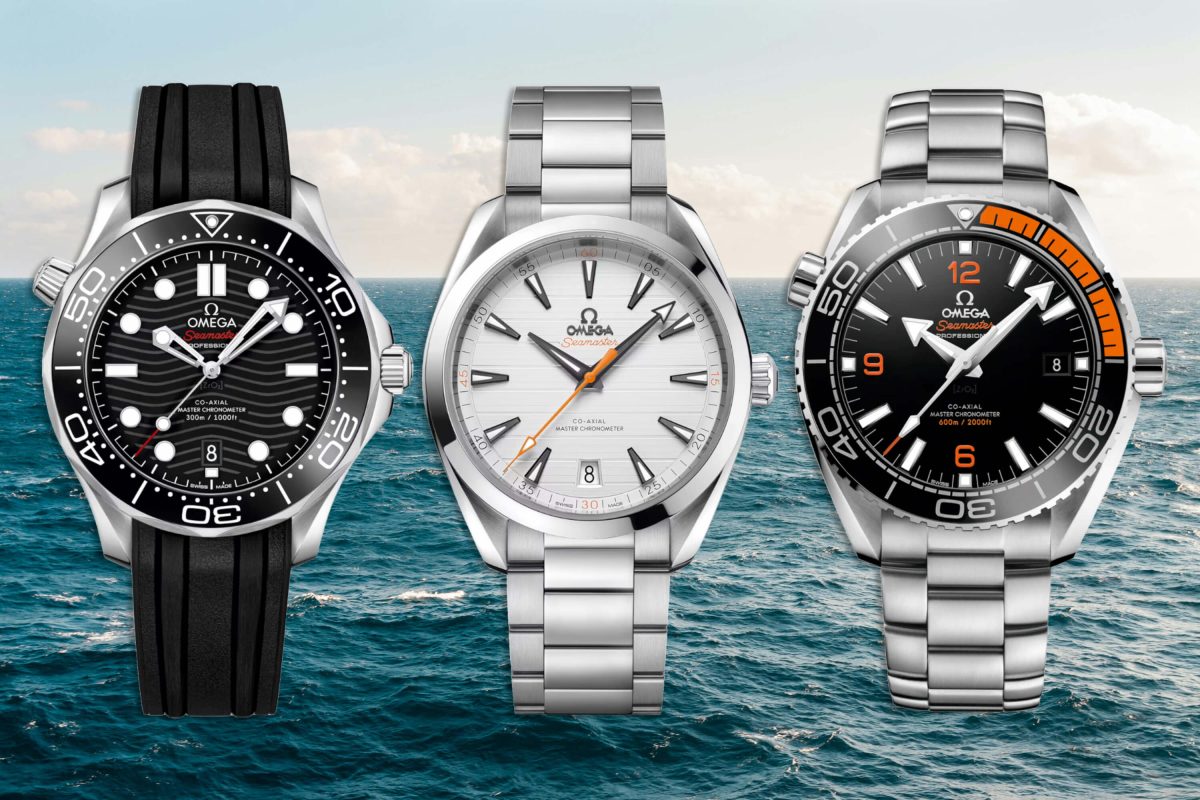
The Seamaster launched in 1948, predating Bond by decades, but the 1995 product placement in GoldenEye transformed it into pop culture royalty. Today the Seamaster Diver 300M is Omega’s best-selling model globally.
The Seamaster Diver 300M delivers: – 300m water resistance with helium escape valve for saturation diving – Ceramic unidirectional bezel with laser-engraved dive scale – Master Chronometer-certified movement (METAS-certified to 15,000 gauss magnetic field resistance) – Available in stainless steel, bicolor, and titanium configurations

Retail pricing runs $5,300–$8,500 for steel Seamaster Diver 300M configurations. The secondary market generally prices cleaned examples 5–15% below retail, making the Seamaster one of the more accessible entry points into certified pre-owned Swiss sports watches.
Looking to compare the Seamaster against its closest rival? See our Omega Seamaster vs. Rolex Submariner breakdown.
Seamaster or Speedmaster sitting in a drawer? We pay top dollar and transfer funds same day.
The Constellation — Precision Dress Watch
First released in 1952, the Constellation is Omega’s statement that dress watches can hold their own technically. The signature “Griffes” (claws) at 12 and 6, the star emblem at 6 o’clock, and fine dial execution define its aesthetic.
The Constellation isn’t a collector craze like the Speedmaster, but it’s a reliable, beautifully finished dress watch with legitimate horological credentials. The Co-Axial escapement reduces friction and extends service intervals significantly compared to traditional lever escapements. Retail pricing begins around $3,500 for quartz models and $5,000+ for automatic Co-Axial configurations.

Which Should You Buy? The Decision Framework
Buy the Speedmaster if: You want historical significance, a hand-wound experience, and strong collector community support. The Moonwatch is the most liquid Omega on the secondary market and the strongest investment candidate. Check our Speedmaster 3861 vs 1861 comparison for the key differences between caliber generations.
Buy the Seamaster if: You want a daily-wear sports watch with serious water resistance, James Bond provenance, and broad versatility from office to ocean. It’s the practical workhorse.
Buy the Constellation if: You want a refined dress watch with a long service interval for formal occasions and business wear, without paying Rolex Datejust premiums.
For a wider view on how Omega compares as an investment vs. Breitling, see: Omega vs. Breitling: Value Retention Analysis
Why Omega Retains Value
Omega belongs to a small group of Swiss brands with sustained secondary market demand across all economic cycles. Key factors:
- NASA and Olympic heritage creates institutional legitimacy no marketing can replicate
- In-house movements (Co-Axial escapement, Master Chronometer certification) validate technical quality
- Limited editions — Apollo anniversary Speedmasters, Bond-specific Seamasters — create genuine collector scarcity
- Cultural permanence via Bond films ensures continuous aspirational demand among younger buyers
Vintage NASA-connected Speedmasters with correct dials and calibers have reached five-figure sums at Phillips and Christie’s. That floor is permanent.
Every Omega in our inventory is authenticated, documented, and ready to ship. No waiting lists, no AD lottery.
Frequently Asked Questions
By sales volume, the Seamaster Diver 300M is Omega’s best-selling model globally. By collector prestige and cultural significance, the Speedmaster Professional Moonwatch is the most iconic and historically important Omega ever made.
They serve different purposes. Rolex leads in resale value consistency and brand recognition across all markets. Omega leads in technical innovation (Co-Axial escapement, Master Chronometer anti-magnetic certification), space history, and value at price point — you get more technical watch per dollar. They’re not direct competitors; most serious collectors own both.
Yes, selectively. The Speedmaster holds value the best, particularly NASA-connected references and limited anniversary editions. The Seamaster Diver 300M in steel trades close to retail on the secondary market. The Constellation depreciates more than the other two, as is typical for dress-category watches without strong collector communities.
The Seamaster Diver 300M, first worn by Pierce Brosnan in GoldenEye (1995). The specific reference has been updated across each Bond film, with Daniel Craig wearing the Seamaster 300M and later the Seamaster Diver 300M in 42mm. Learn more in our James Bond watches history.
Omega recommends servicing every 5–8 years depending on usage, water exposure, and model. Master Chronometer models with Co-Axial escapements have longer service intervals than traditional lever-escapement models due to reduced friction in the gear train.
 Free Shipping for all orders