

















Sep

QUICK ANSWER
The best factory-original Rolex hardstone dials can command premiums of 100% to 300% or more over conventional configurations because every mineral slice is unique, extraordinarily difficult to manufacture, and scarce in flawless condition. With stone layers historically cut to around 0.4 mm, fractures, rejected blanks and surviving rarity drive collector demand.
Natural-stone Rolex dials are no longer an obscure vintage curiosity.
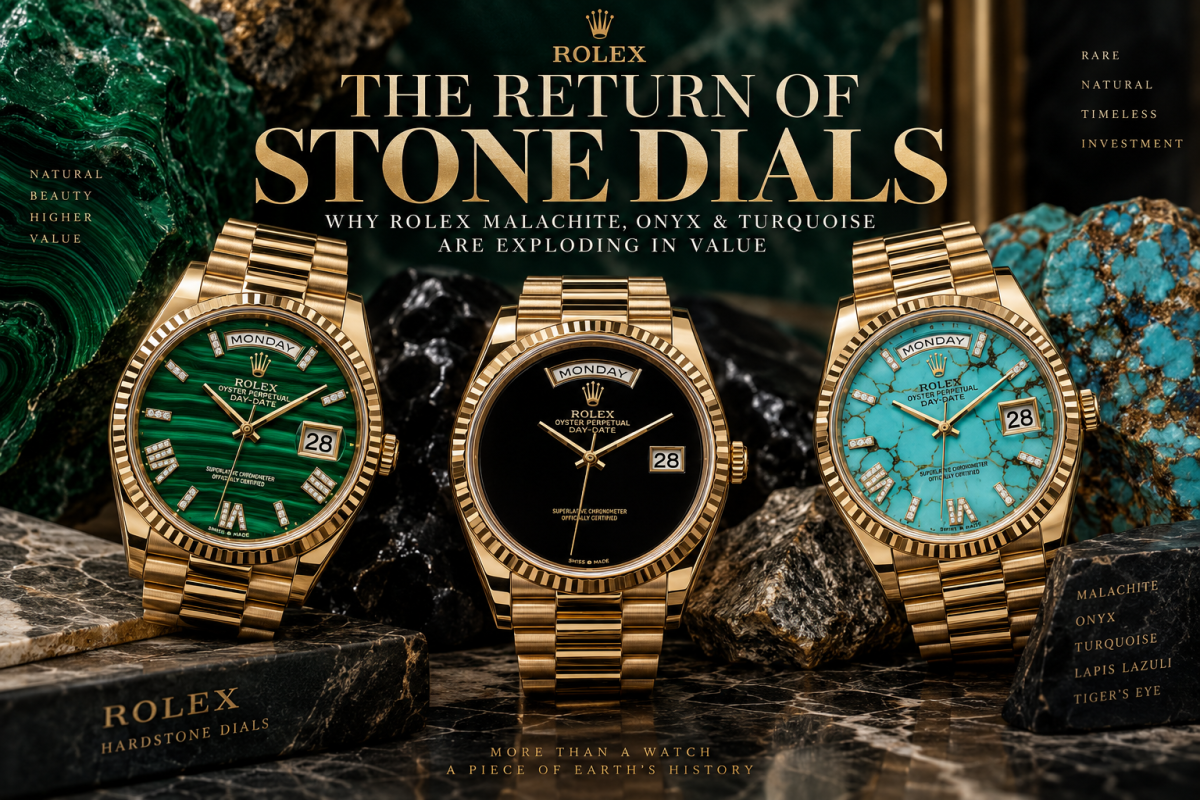
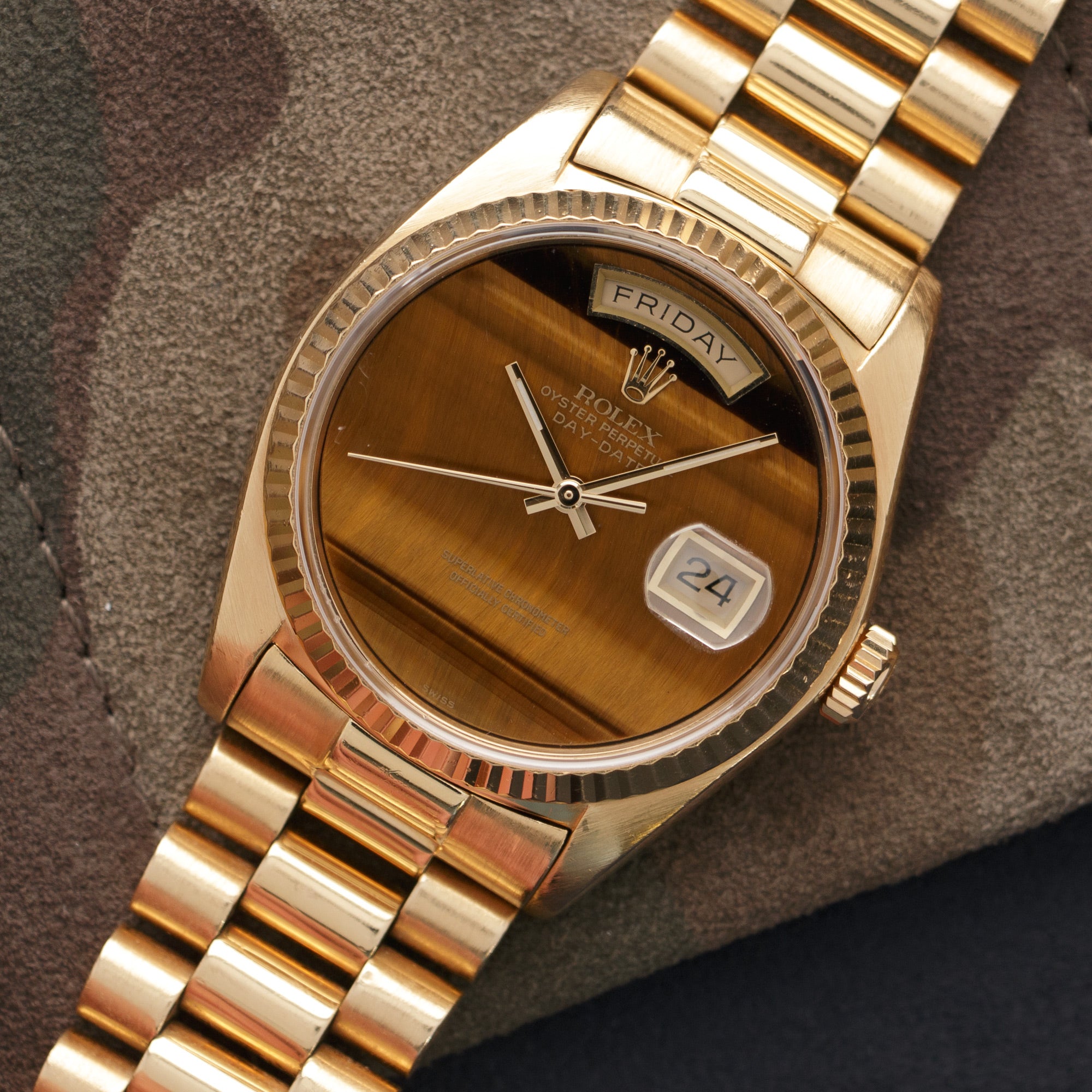
In 2026, malachite, turquoise, onyx, tiger’s eye, lapis lazuli, sodalite and aventurine sit at the intersection of three collector obsessions: scarcity, individuality and provenance. Phillips has highlighted renewed interest in hardstone watchmaking, while Rolex itself reinforced the trend this year with the new Day-Date 40 in Jubilee Gold and natural green aventurine.
Unlike a lacquer or sunburst dial, a stone dial cannot truly be duplicated. Veins, mineral inclusions and tonal shifts belong to one geological slice. Two watches carrying the same Rolex reference can therefore have noticeably different personalities.
And collectors are increasingly paying for the dial, not merely the reference stamped between the lugs.
The Fragile Art: How Stone Dials Are Crafted

Turning a mineral into a watch dial is closer to lapidary work than conventional dial production.
The process begins by choosing a section of raw stone for color, grain and structural integrity. The material must then be cut into an extremely thin disc, stabilized on a metal base, machined for the central pinion and calendar openings, polished and fitted without creating fractures.
Historical research cited by Phillips documents a 1977 Rolex Datejust lapis lazuli dial whose stone layer measured only 0.4 mm. Phillips also describes Rolex hardstone constructions using approximately 0.15 mm of supporting metal, bringing total dial thickness to about 0.65 mm.
Ultrasonic machining was developed to create openings in these fragile mineral surfaces without destroying them.
The often-repeated claim that exactly “60% crack during production” is not an official Rolex statistic. The important point is more extreme: hardstone production involves exceptionally high rejection and wastage because natural material can contain hidden weaknesses.
That fragility partly explains why Rolex historically limited stone-dial production and why intact vintage examples carry such disproportionate value.
The Holy Trinity of Rolex Stone Dials
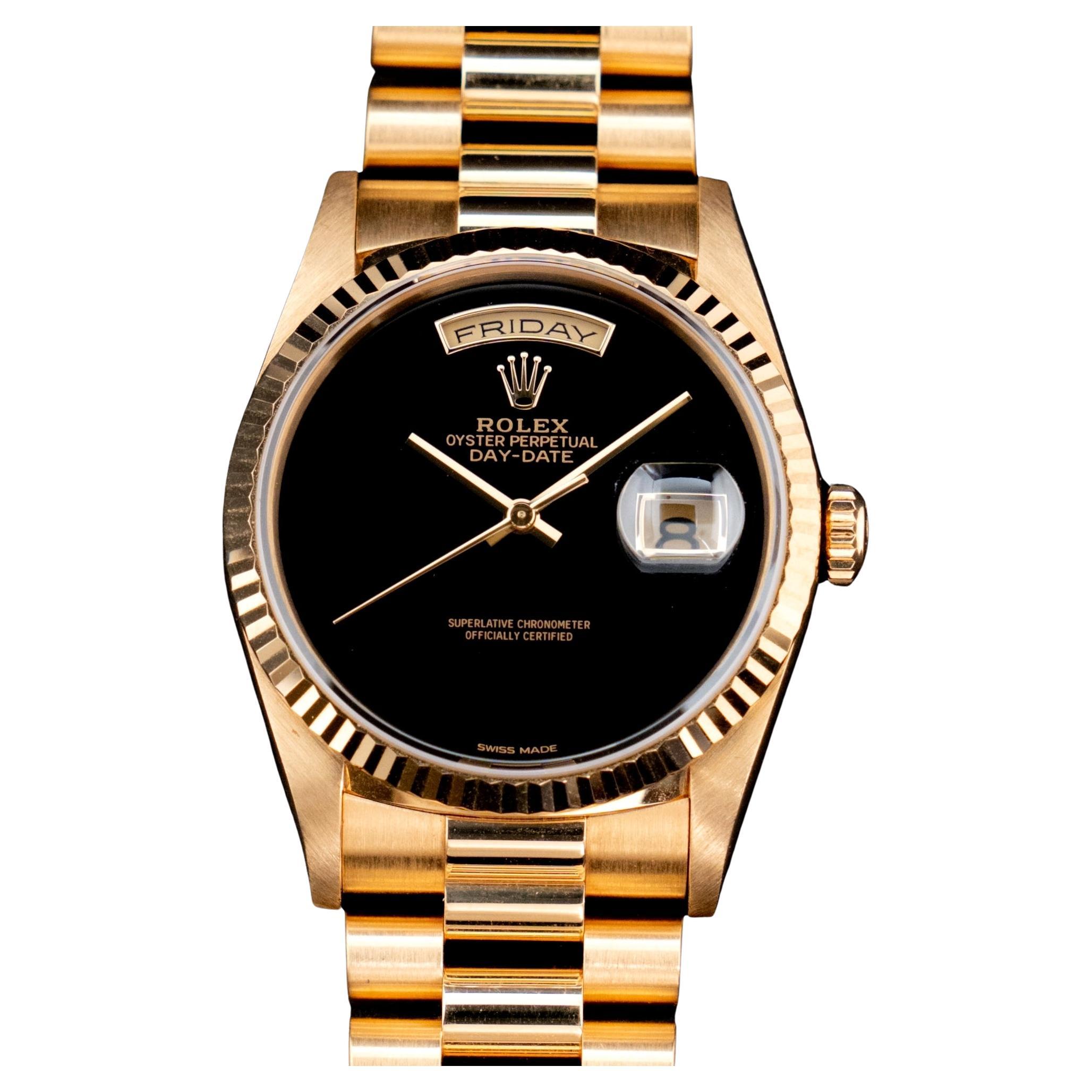
Rolex experimented with an extraordinary catalogue of stones including lapis lazuli, coral, jade, jasper, sodalite, tiger’s eye and chrysoprase. Yet three materials have become especially recognizable in the modern collector market: malachite, black onyx and turquoise.
They could hardly be more different.
Malachite celebrates geological movement. Onyx removes almost everything. Turquoise delivers the intense color associated with today’s most aggressive collectible Rolex market.
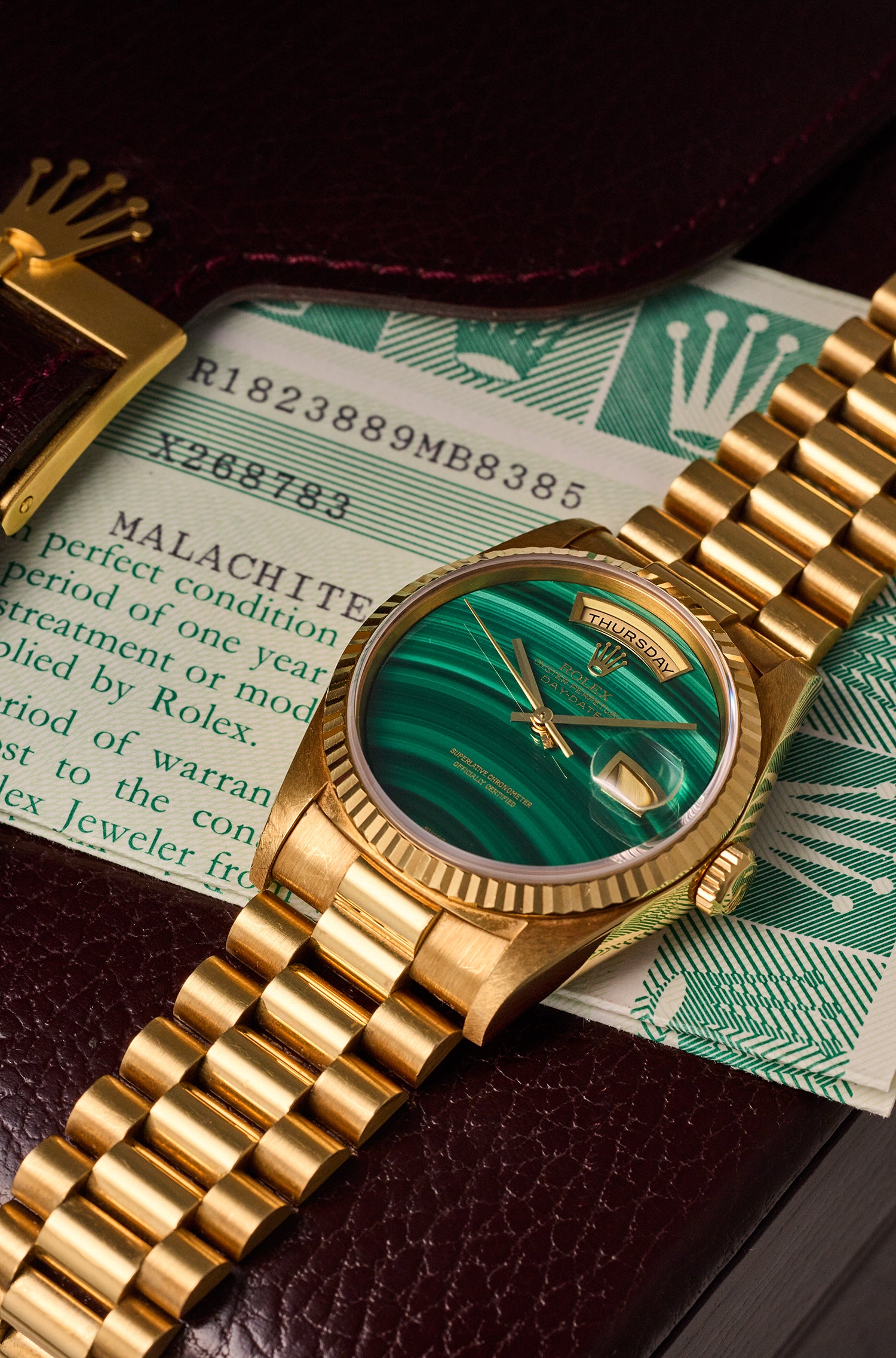
Malachite Day-Date: The Green Dial That Cannot Be Repeated
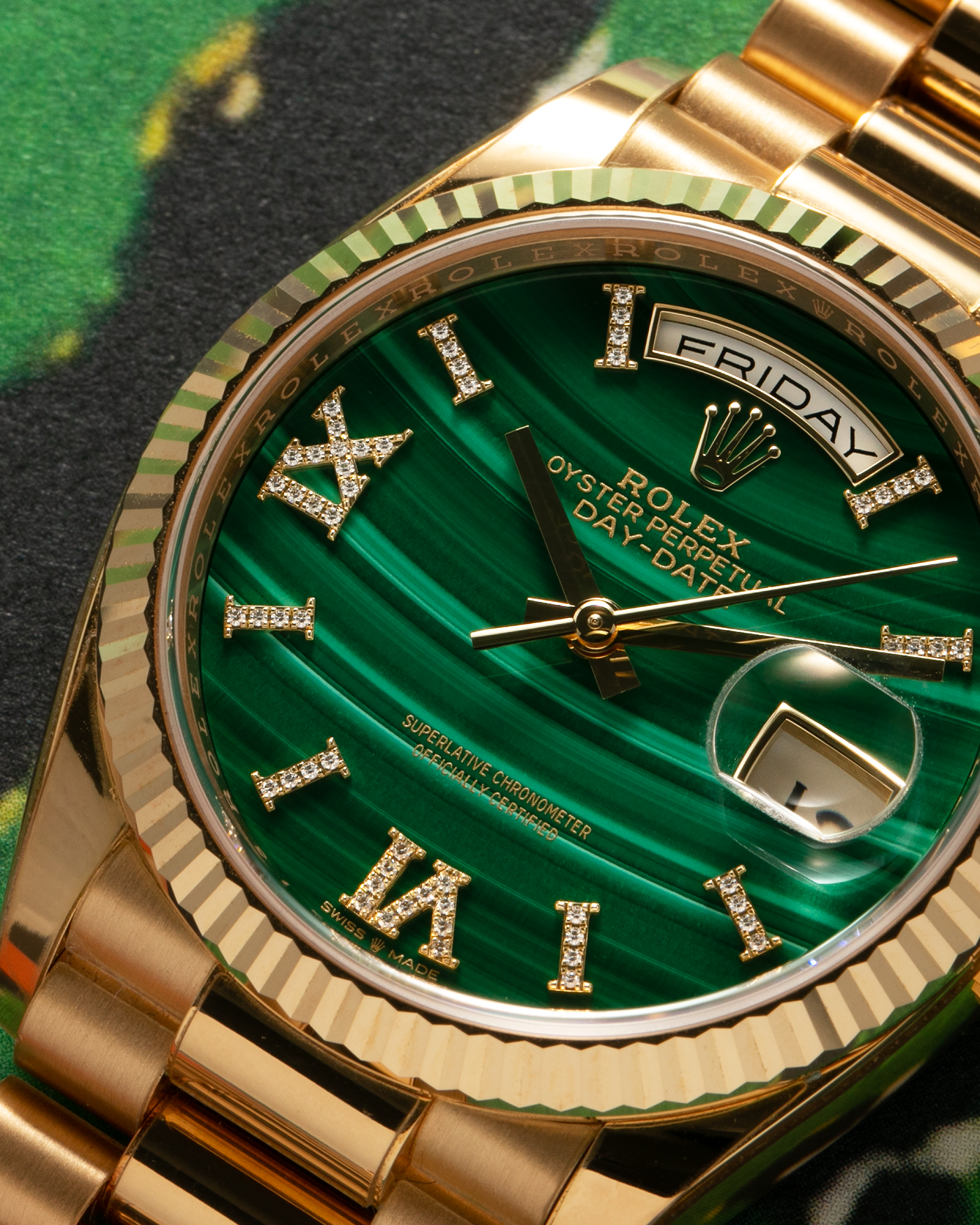
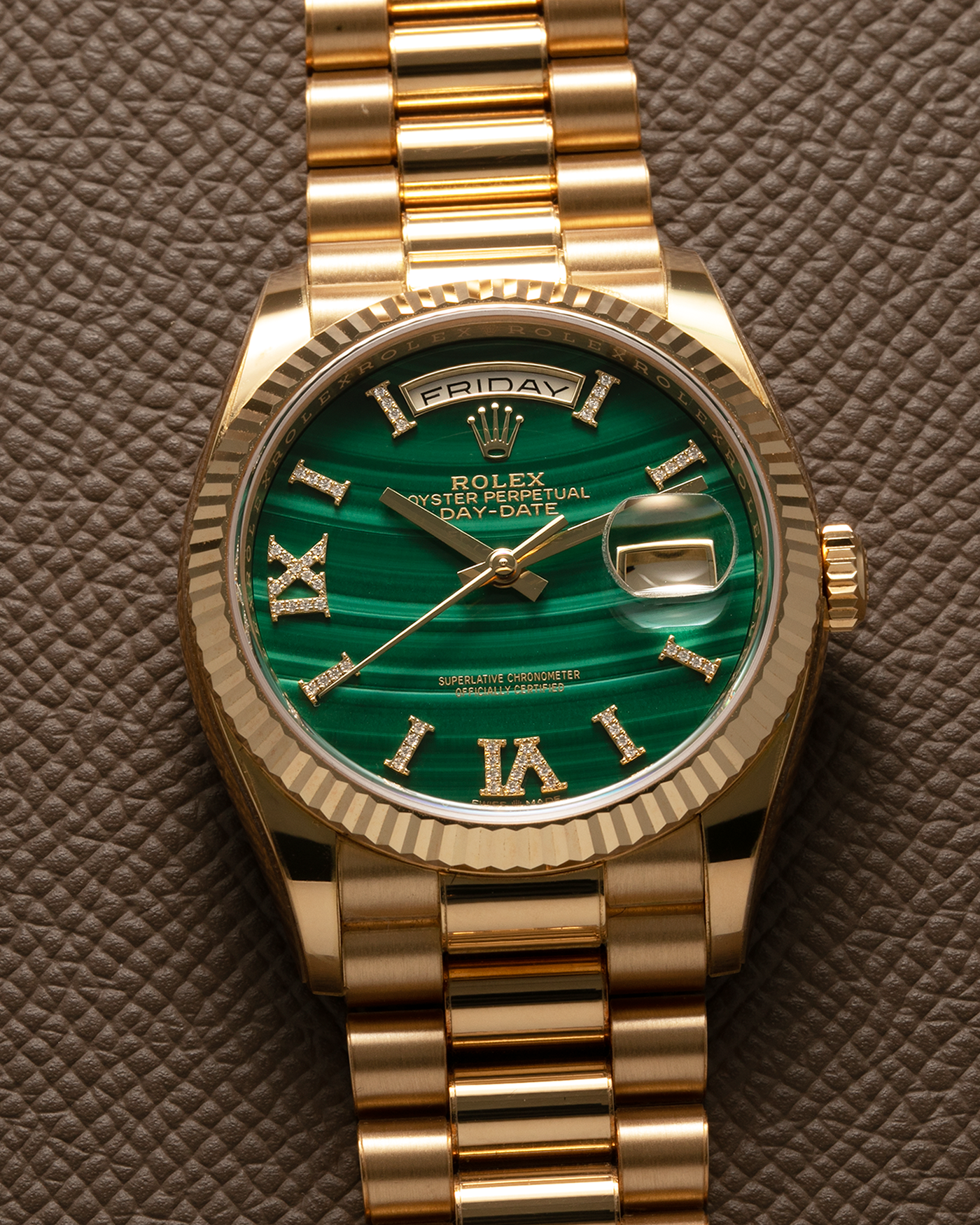
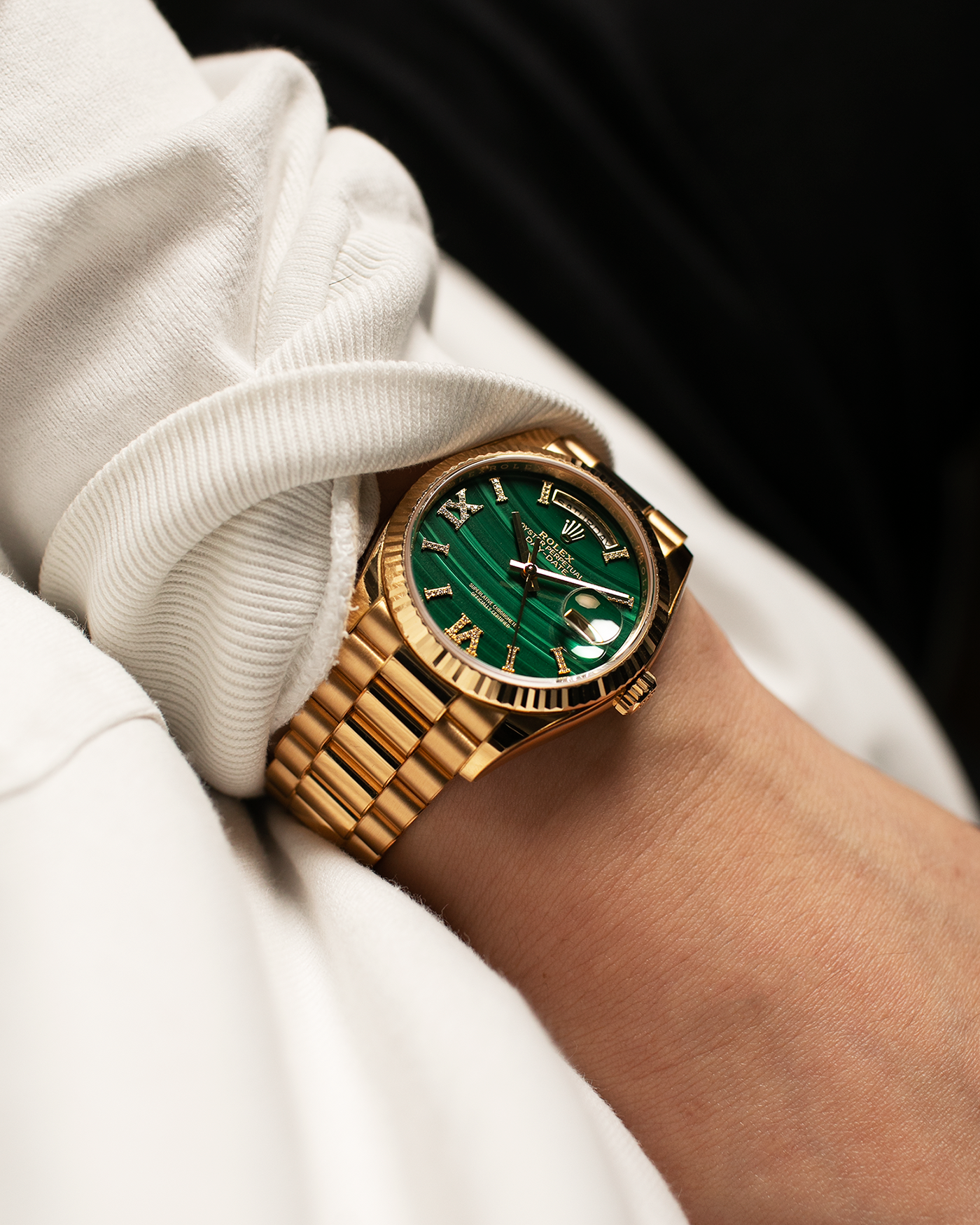
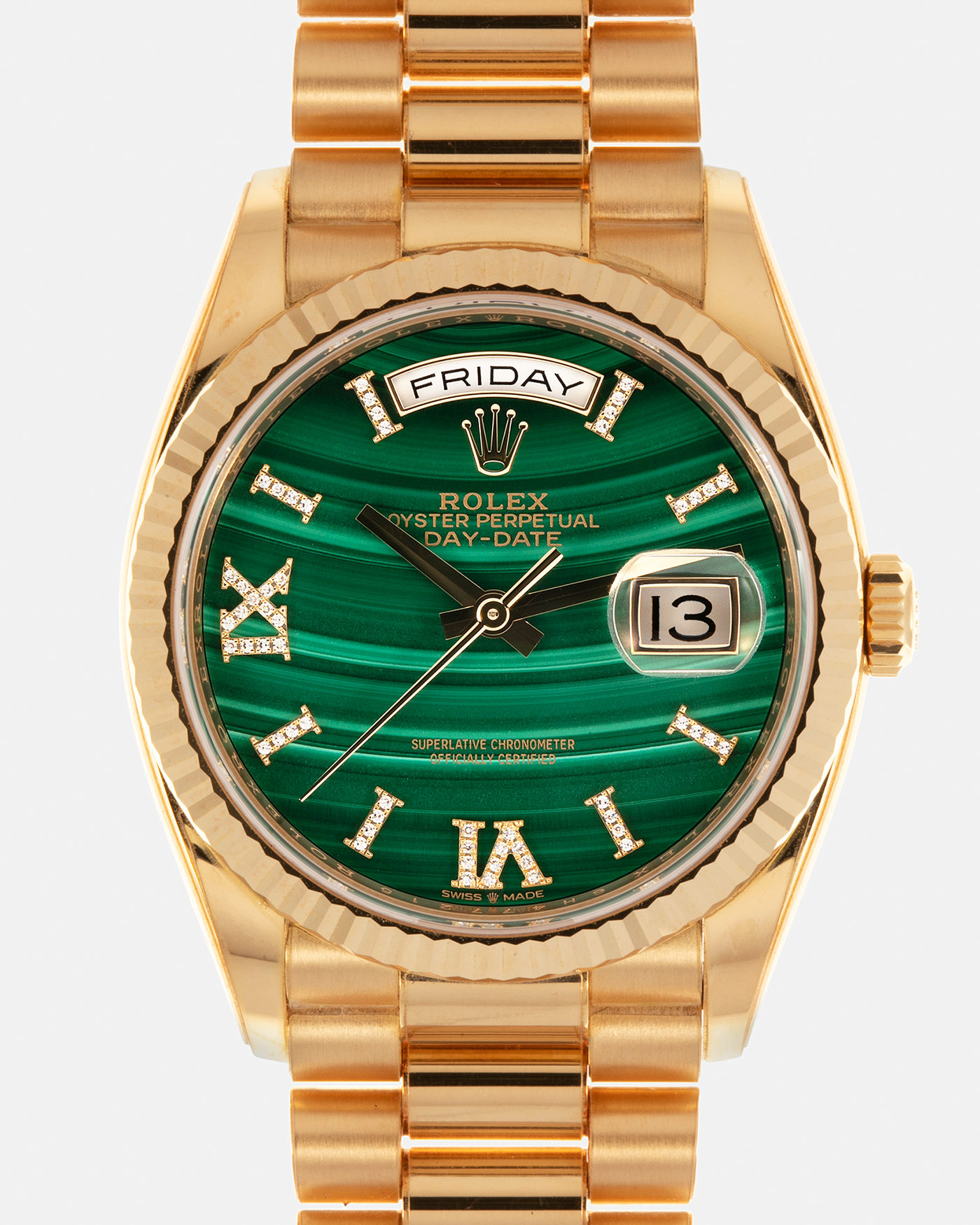
The modern Day-Date 36 ref. 128238 Malachite may be the clearest expression of the category.
Green bands sweep across the dial in irregular layers while diamond-set Roman-style markers sit above the stone. No printing technique can reproduce those patterns because they existed in the mineral long before Rolex cut the wafer.
Documented examples pair the malachite dial with an 18k yellow-gold case and President bracelet. A September 2026 secondary-market listing tracked by EveryWatch reached roughly $93,459, while Rolex currently lists standard yellow-gold ref. 128238 configurations from $45,900 and a bright-green diamond configuration at $50,650.
That produces an excellent example of a near-100% scarcity premium.
One caution: ref. 228238 is a legitimate yellow-gold Day-Date 40, but publicly documented factory malachite examples are far less established than 128238 examples. Provenance matters enormously when a seller claims a rare factory configuration.
Jet-Black Onyx: Rolex Minimalism at Its Most Extreme
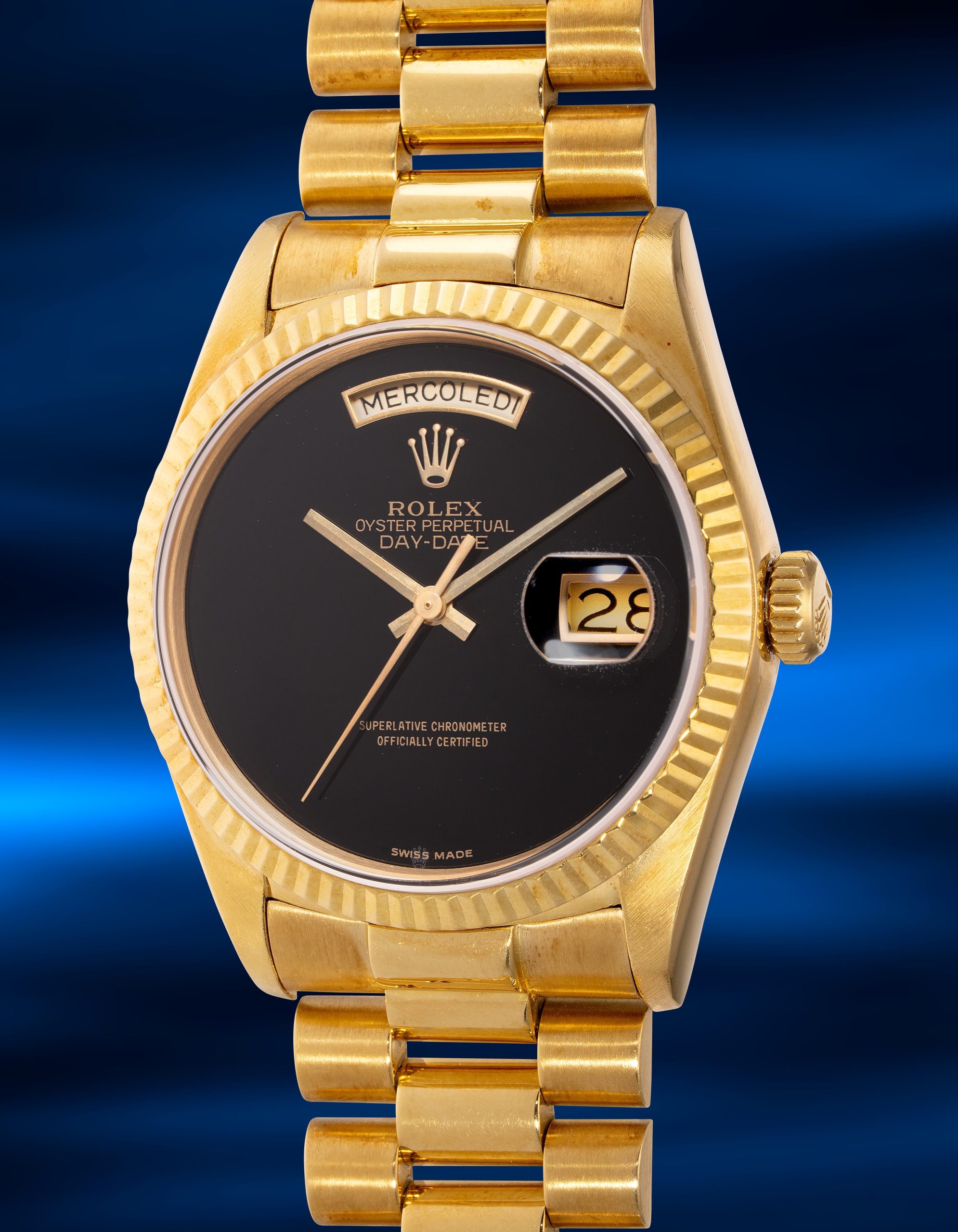
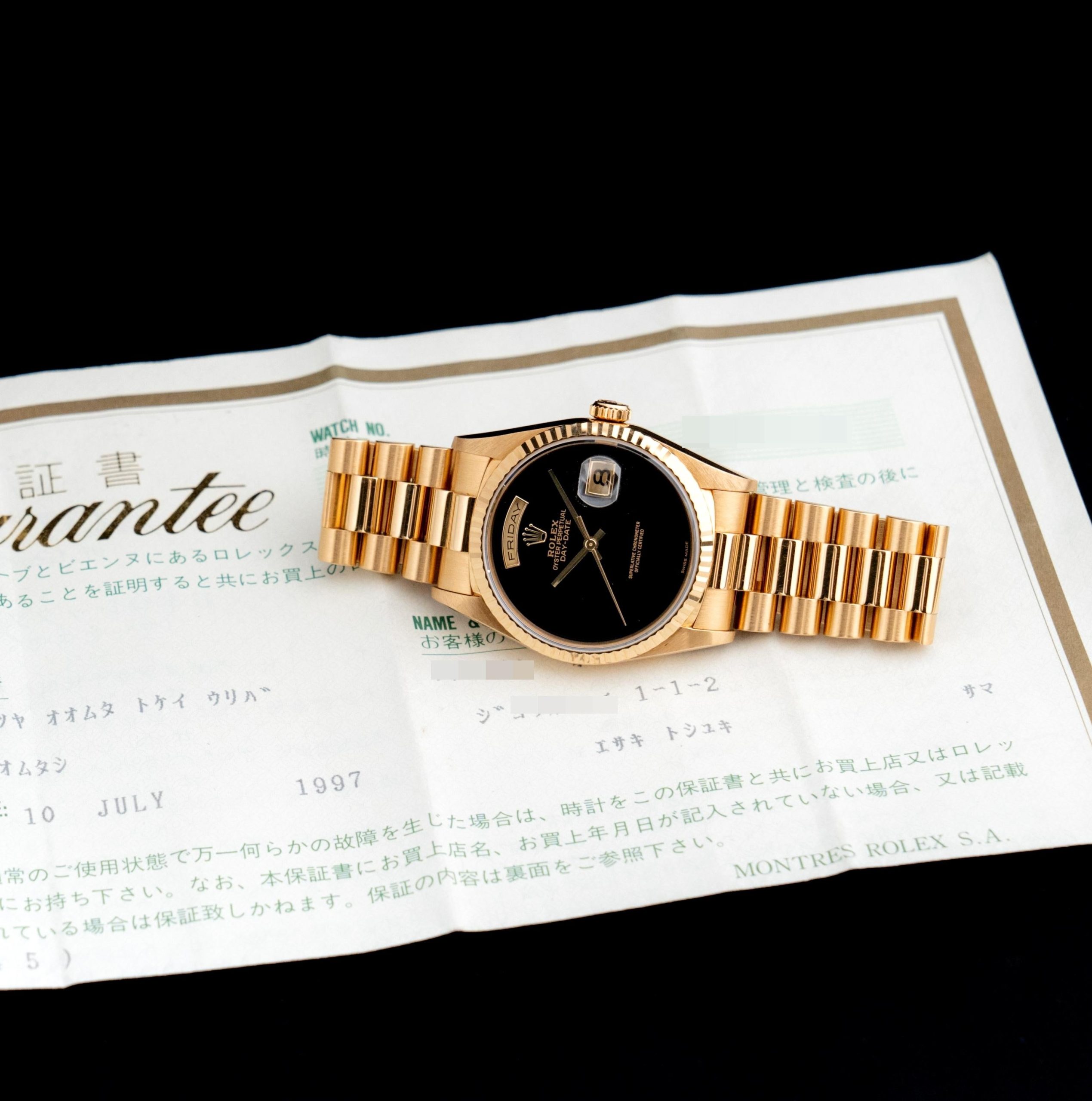
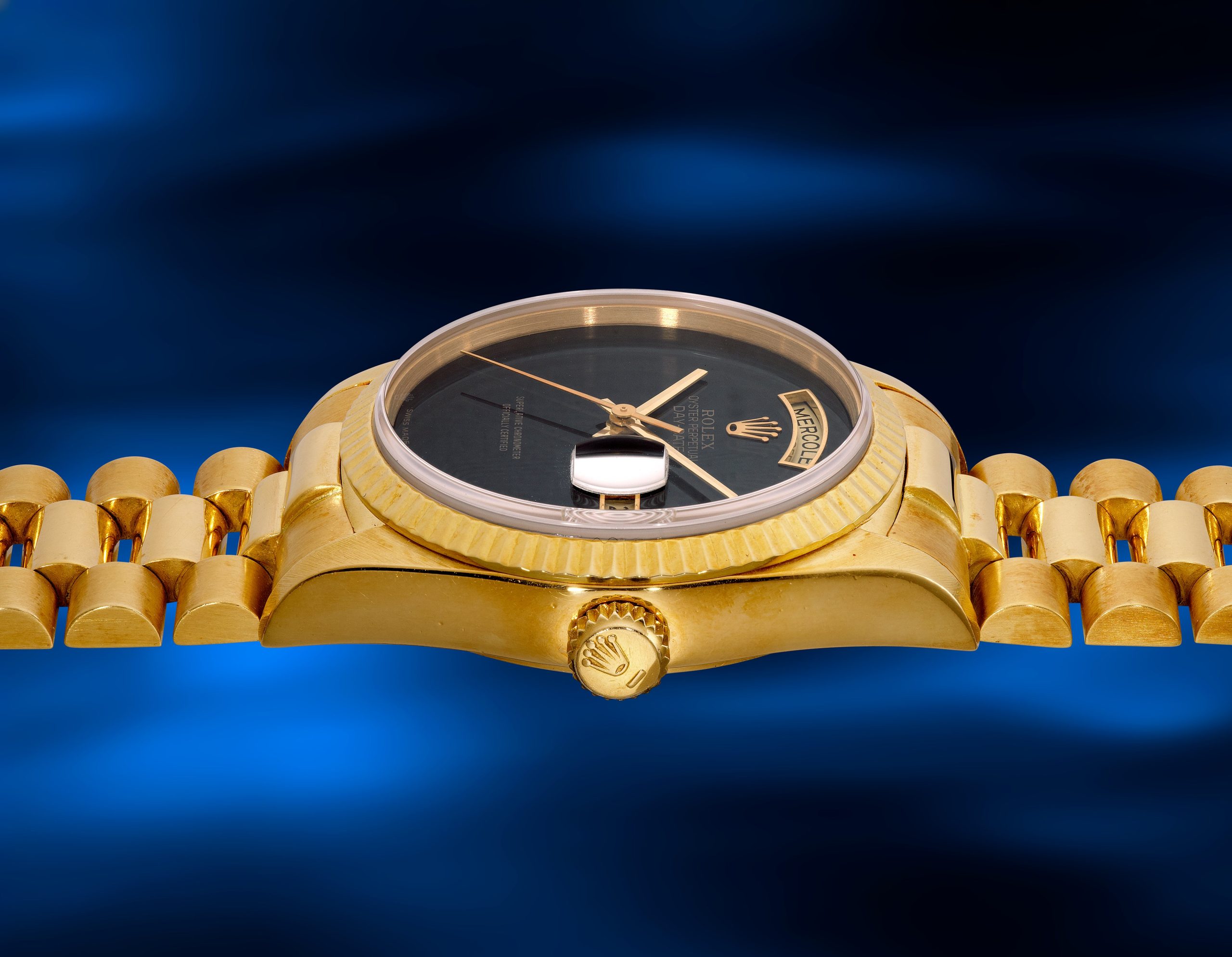
Onyx is the opposite of malachite.
Instead of displaying dramatic veins, the finest examples create a deep black mirror. Some vintage Day-Date executions omit conventional hour markers entirely, allowing the stone to dominate the architecture.
Phillips sold a circa-1984 Day-Date ref. 18038 with a naked onyx dial for HK$215,900 in 2026. Another ref. 18238 hardstone onyx example sold for CHF48,260 during the 2026 Geneva Sessions.
Why remove the markers?
Aesthetic purity is part of the answer, but manufacturing matters too. Every aperture or fitting creates another opportunity to damage an extremely thin mineral wafer.
Against yellow gold, the absence of markers makes onyx one of the most architecturally clean Rolex configurations ever produced.
Turquoise: The Electric Blue Hardstone Trophy
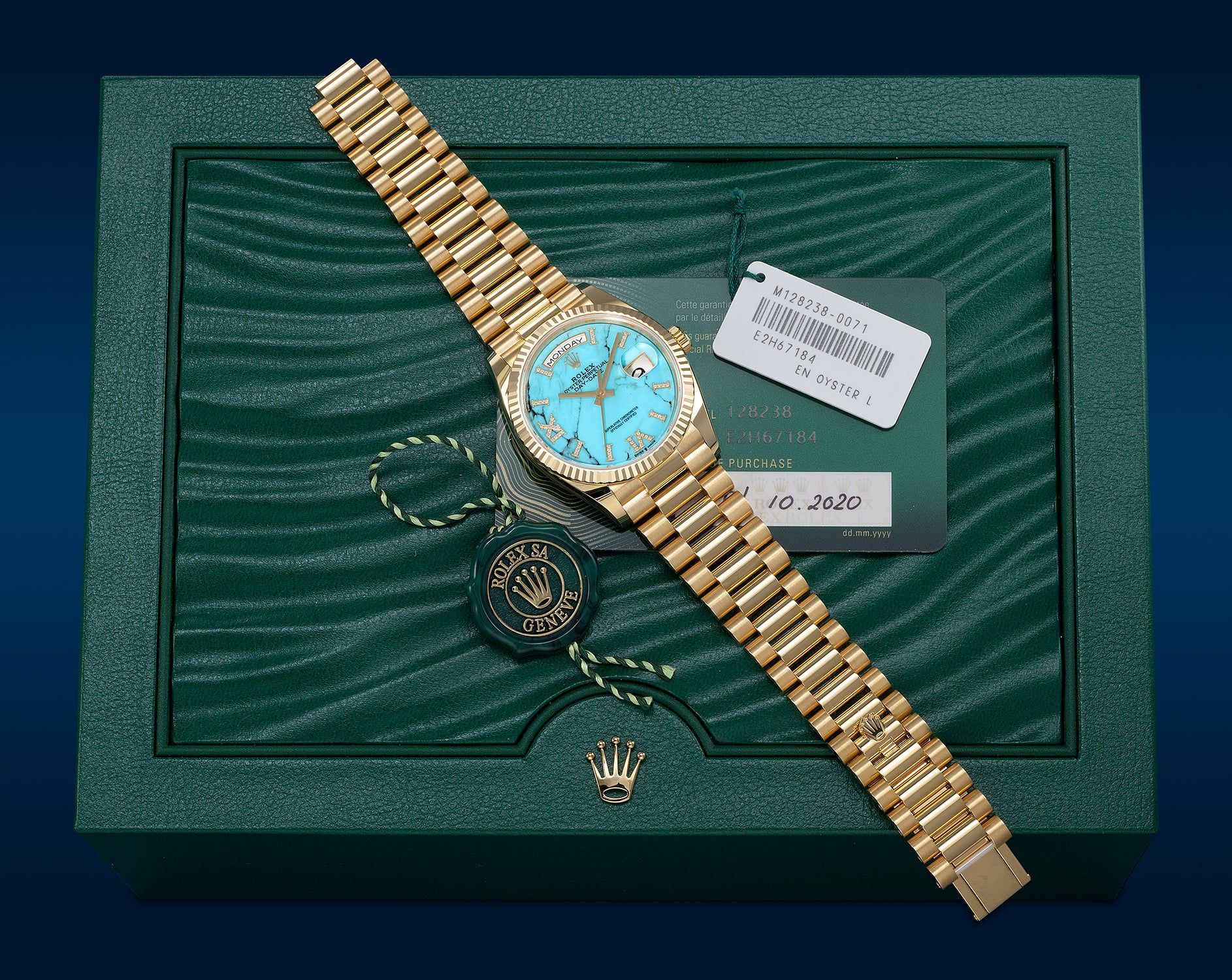
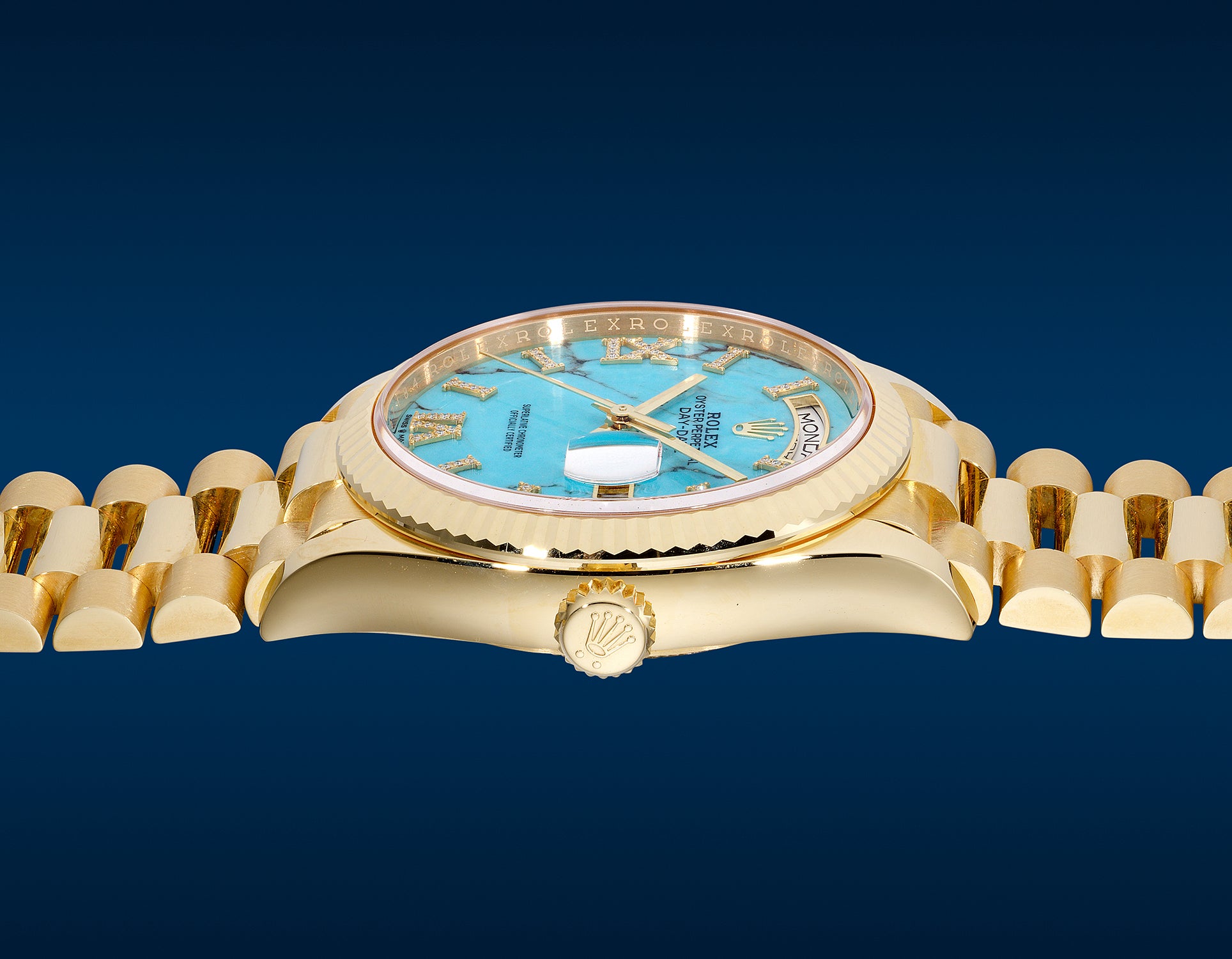
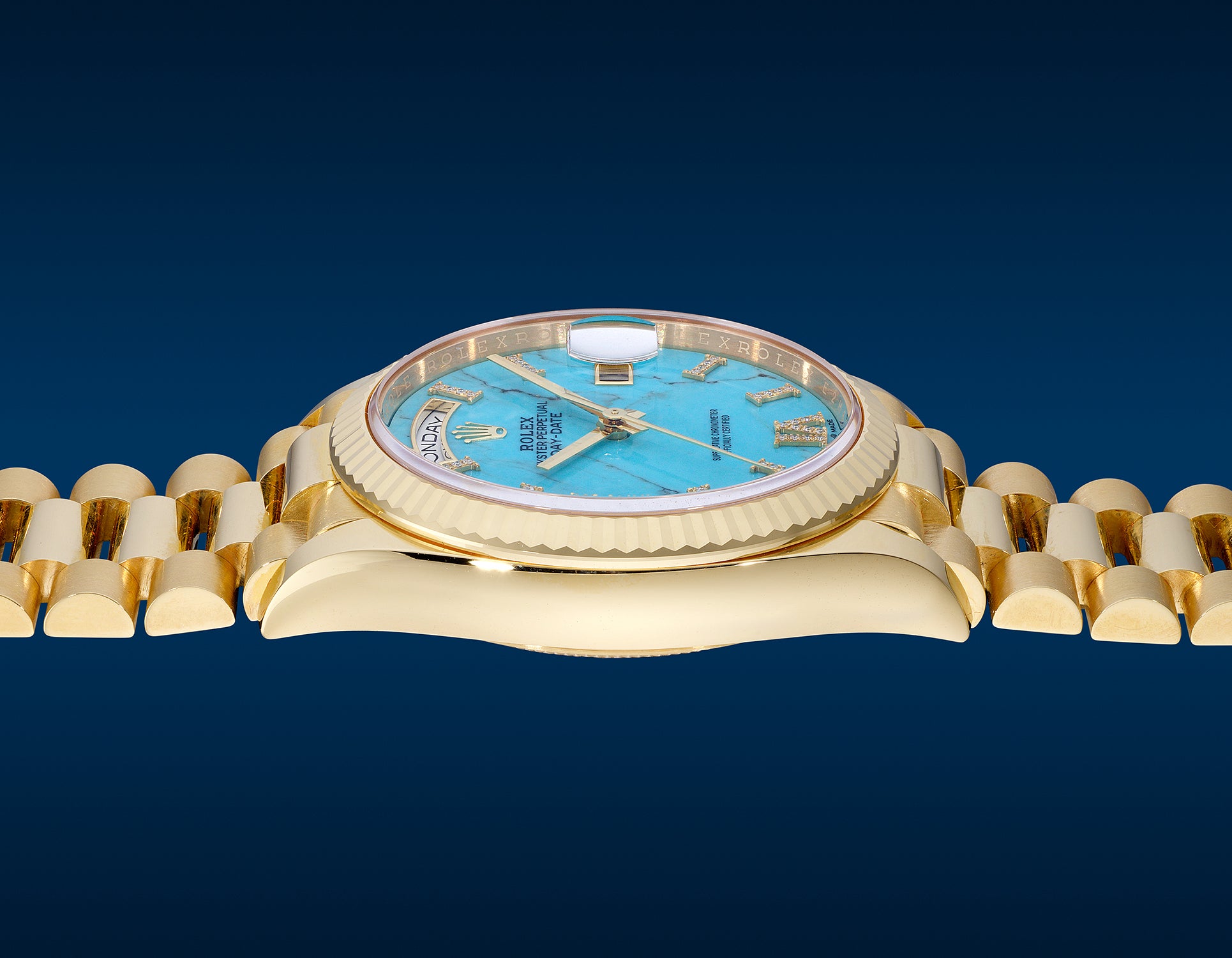
Turquoise may be the most immediately recognizable modern Rolex hardstone.
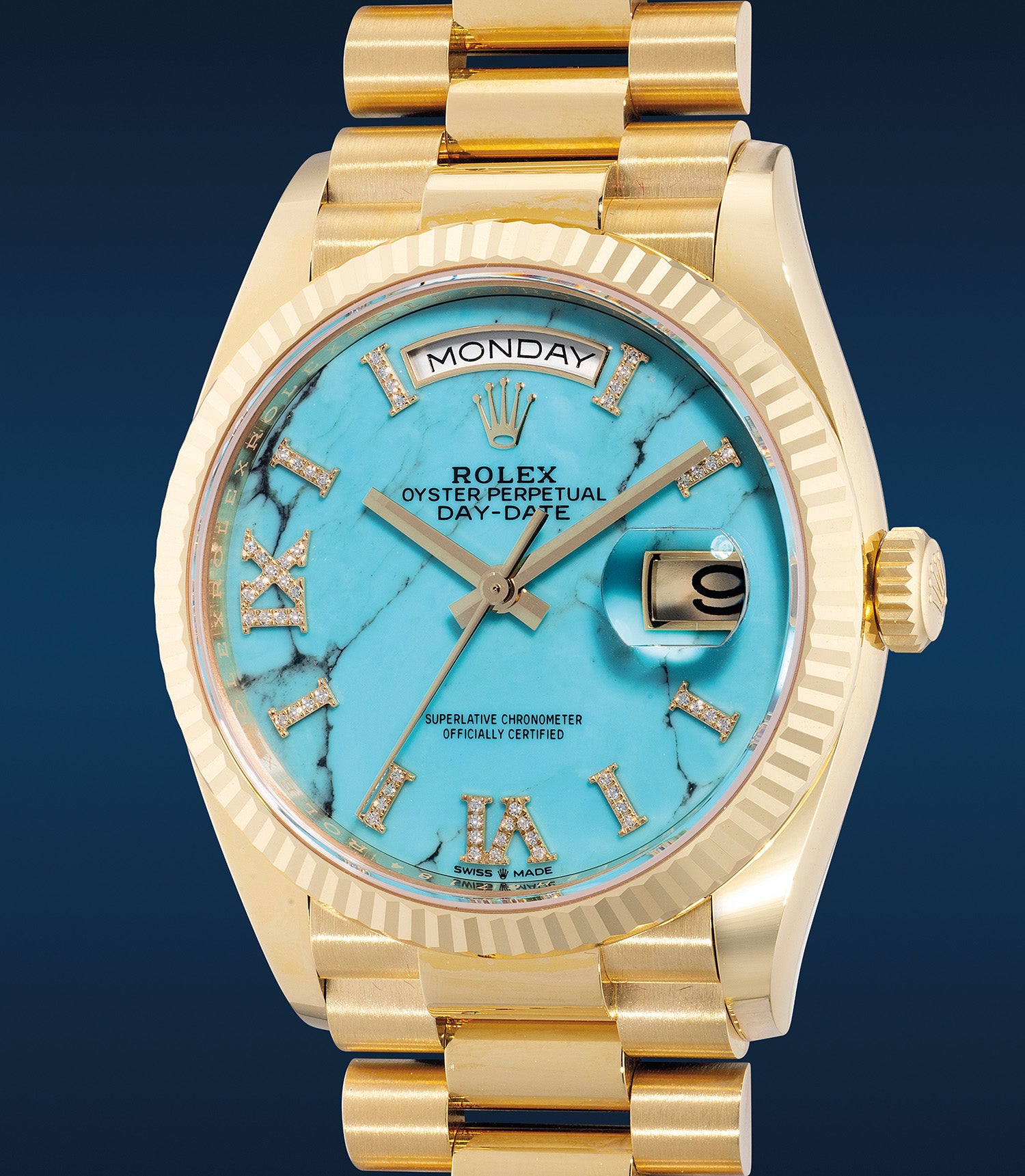
The Day-Date 36 ref. 128238 combines yellow gold with an almost electric sky-blue mineral dial crossed by naturally occurring darker matrix veins. Phillips specifically describes every turquoise piece as organic and unique.
A like-new 2020 ref. 128238 with turquoise dial sold at Phillips for HK$533,400, dramatically above its HK$180,000–360,000 estimate. Christie’s subsequently sold another example for $75,600 in 2025.
One distinction is essential: turquoise hardstone is not a Stella dial.
Stella Rolexes use brightly colored enamel or lacquer. Turquoise is mineral. Both participate in the renewed appetite for intense Rolex colors, but their construction and collector significance are different.
Vintage Stone Dials vs. Modern 2020s Releases: Where Collector Attention Is Moving
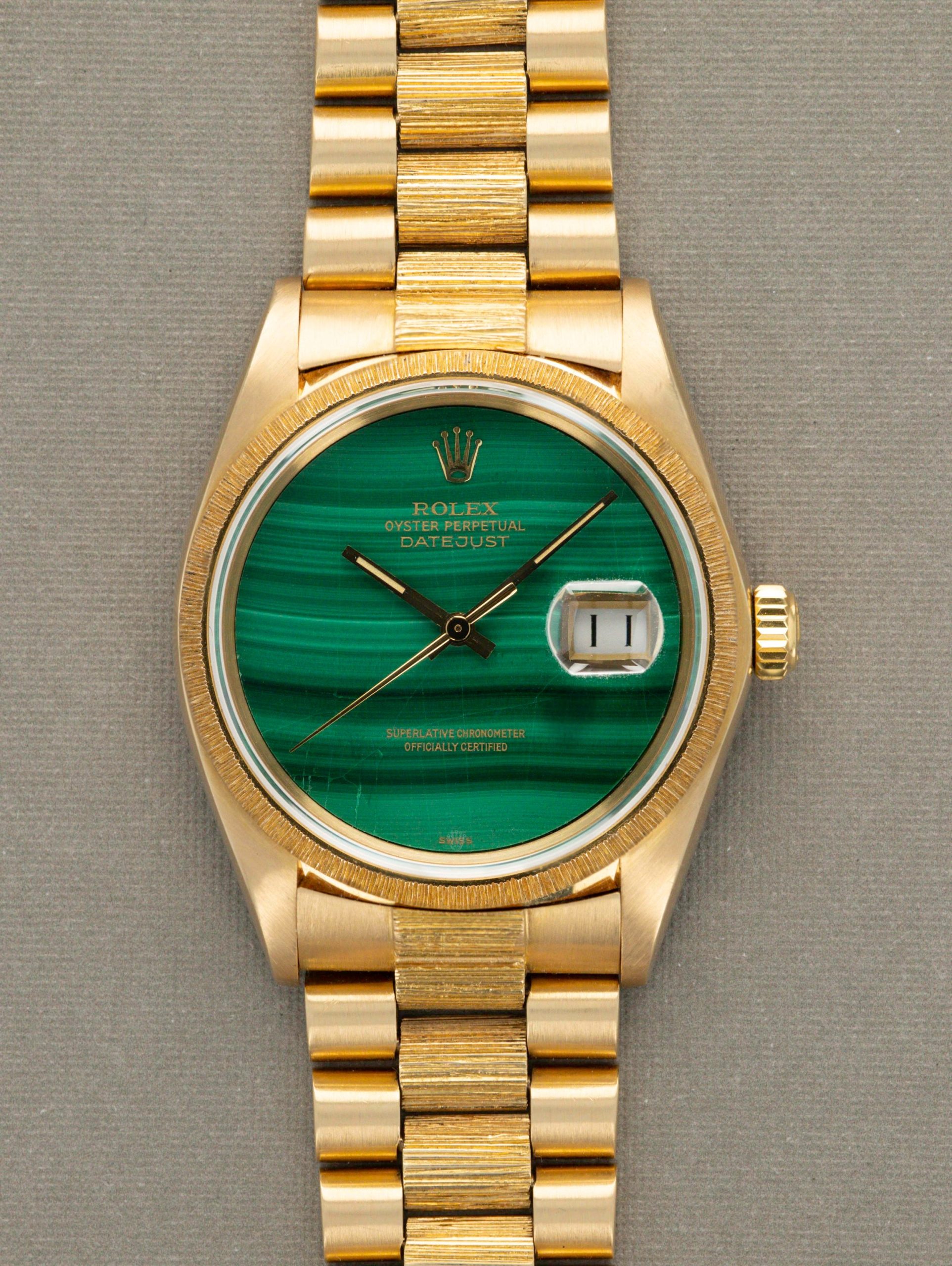
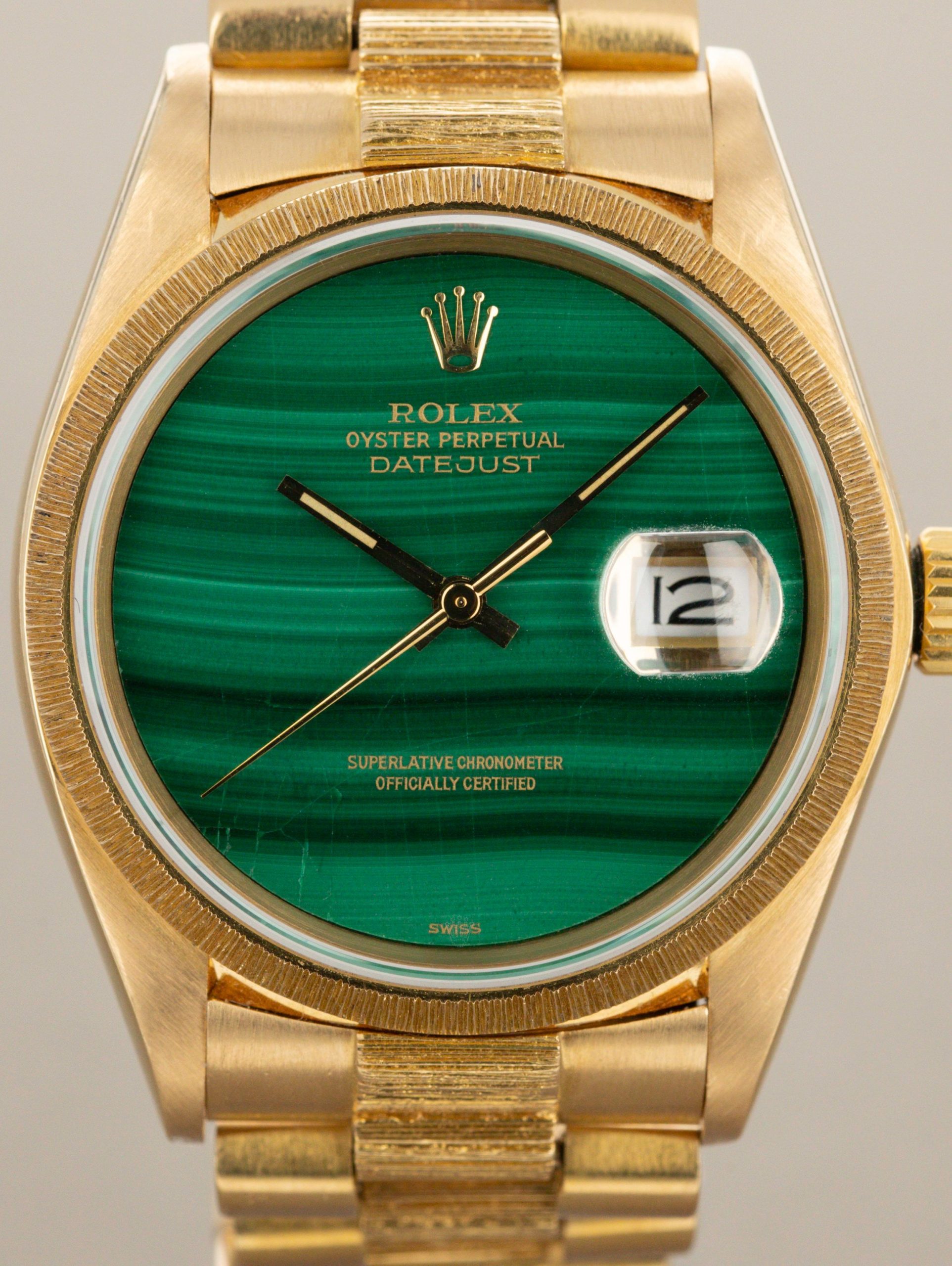
Vintage is where scarcity becomes brutal.
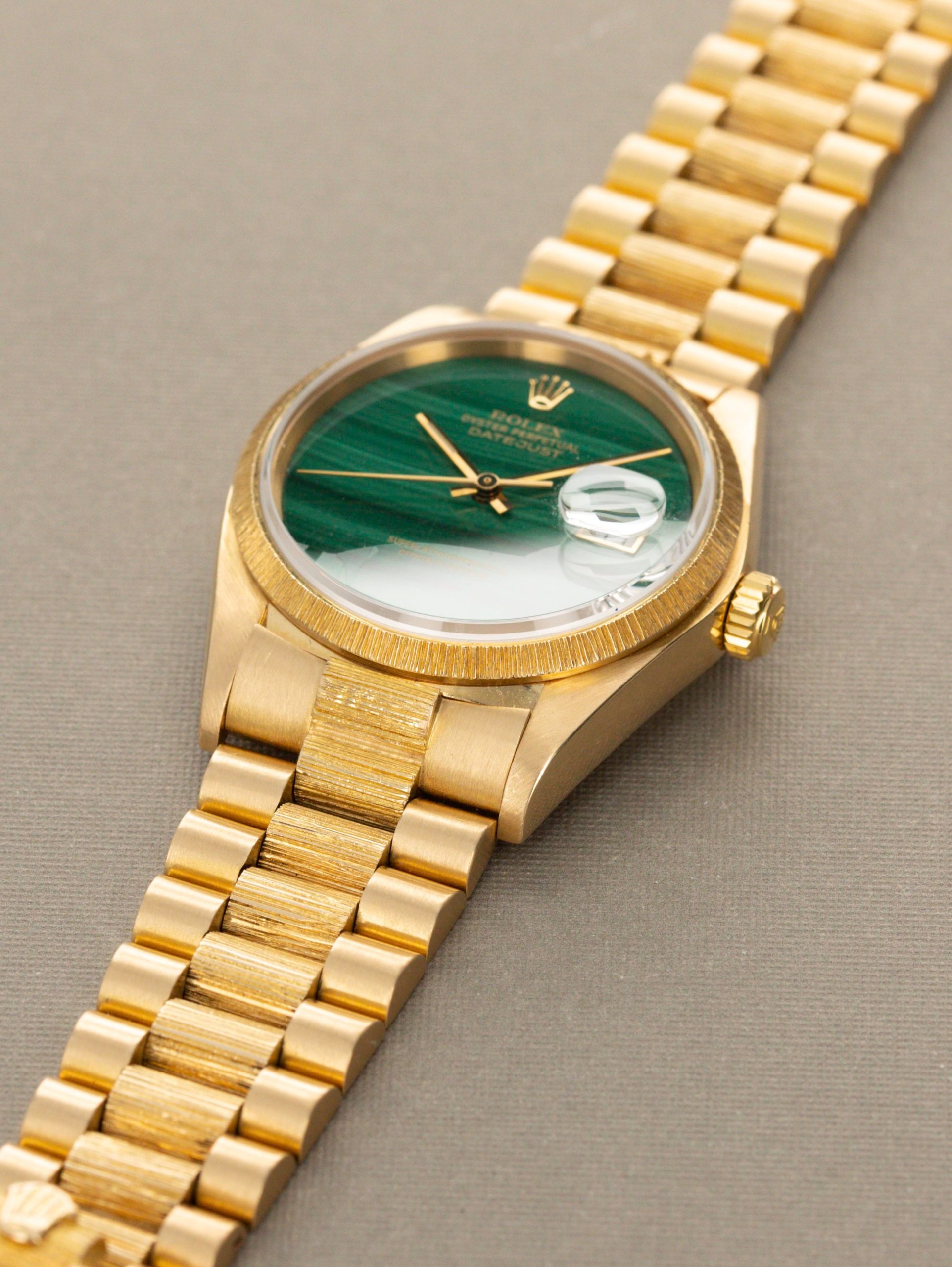
A circa-1979 Datejust ref. 16078 photographed by Oliver & Clarke displays visible cracking around the lower portion of its malachite dial. The dealer explicitly notes that cracking is common in vintage stone-dial Rolexes.
Condition therefore matters far more than reference number alone.
At the top of the vintage market, provenance can produce extraordinary results. Phillips sold a 1995 Day-Date ref. 18238 with flawless factory malachite dial, original warranty and presentation box for $203,200 in June 2026, against a $40,000–$80,000 estimate.
Modern collectors now have another route.
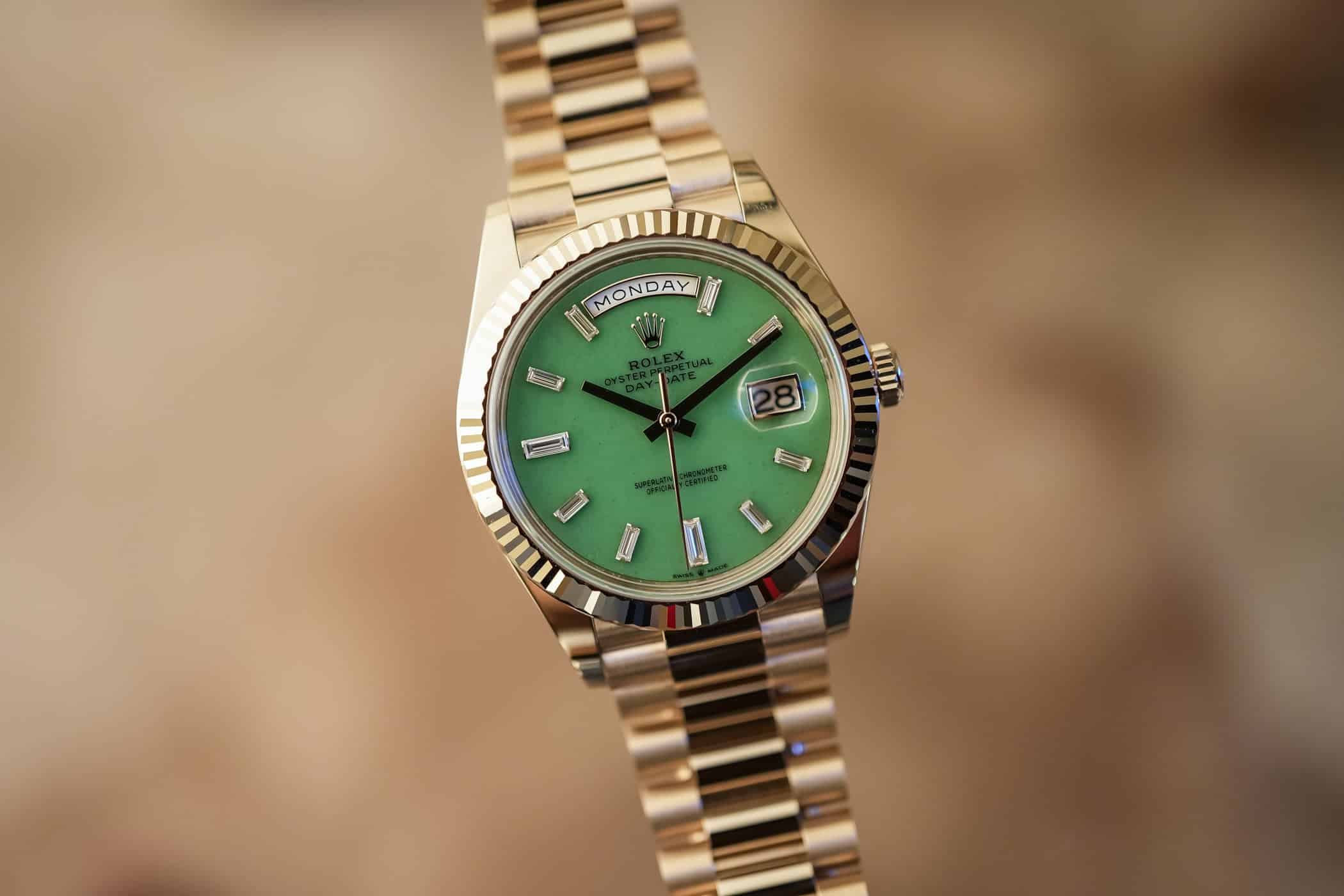
For 2026 Rolex introduced the Day-Date 40 ref. 228235JG in its new Jubilee Gold alloy with a natural light-green aventurine dial and ten baguette diamonds. Rolex confirms both the natural quartz-family stone and a U.S. retail price of $65,700.
Vintage offers historical scarcity. Modern hardstone offers cleaner provenance and current Rolex engineering.
Stone Dial Value & Premium Comparison: 2026
| Model | Retail / standard benchmark | Stone-dial market evidence | Approx. premium signal |
|---|---|---|---|
| Day-Date 36 ref. 128238 Malachite | $45,900 standard 128238 | ~$93,459 Sep. 2026 listing | ~104% |
| Day-Date 36 ref. 128238 Turquoise | $45,900 standard 128238 | $79,125 Jan. 2026 listing | ~72% |
| Day-Date ref. 18238 Onyx | Standard 18238s often trade far lower | CHF48,260, 2026 Phillips | Strong hardstone premium |
| Day-Date ref. 18238 Malachite | Generic 18238 auction examples around ~$20K–30K | $203,200, June 2026 | Exceptional multiples, not percentages |
| Day-Date 40 ref. 228235JG Aventurine | $65,700 MSRP | New 2026 release | Market still forming |
Sources: Rolex, Phillips and 2026 secondary-market tracking.
The lesson is not that every stone dial automatically doubles or triples.
The strongest premiums appear when factory originality + exceptional stone pattern + condition + rare configuration + provenance converge.
5 Essential FAQs for Buying and Authenticating Stone-Dial Rolexes
1. How can I authenticate a stone dial?
Check whether the precise dial existed for the reference and production period. Typography, day/date apertures, stone construction, dial feet, service history and provenance should be examined by a specialist.
2. Is a hairline crack serious?
Yes. A crack affects both condition and liquidity. Unlike a cosmetic scratch, it is structural damage to the mineral itself.
3. What about aftermarket malachite or turquoise dials?
They may look attractive but should never be valued like documented factory Rolex hardstone.
4. Are some natural patterns more valuable?
Potentially. Dramatic malachite banding, attractive turquoise matrix or strong tiger’s-eye chatoyancy can make one example visually superior to another.
5. Should I buy stone Rolexes purely as investments?
No return is guaranteed. The strongest collector case remains the rarest original example in the best condition with the best documentation.
Inquire About Rare Stone-Dial Timepieces at Luxury Watches USA
A serious stone-dial Rolex should be evaluated more like a piece of natural art than a conventional dial variation.
The reference matters, but so does the exact slice of mineral. Condition matters. Provenance matters. Original papers matter. And on the rarest watches, the difference between a factory stone dial and an aftermarket replacement can represent tens of thousands of dollars.
Explore the Rolex Day-Date collection and Diamond Watches at Luxury Watches USA for current inventory and private sourcing opportunities.
For collectors pursuing malachite, turquoise, onyx, lapis lazuli, tiger’s eye, sodalite or other rare Rolex hardstone configurations, the hierarchy is simple:
Buy originality first. Buy condition second. Buy the beauty of the individual stone third.
Gold can be polished. A movement can be serviced. A bracelet can be restored.
A flawless natural stone dial that has survived decades intact is considerably harder to replace.
 Free Shipping for all orders