

















Oct
Quick Answer: Choose the IWC Portugieser Chronograph (IW3714 / IW3716) if you want a refined, dress-forward luxury chronograph with a slim 12.6–13.0 mm profile, an expansive minimalist dial, and effortless cuff clearance for professional, business, and formal settings. Choose the IWC Pilot’s Watch Chronograph (IW3777 Classic 43 mm or IW3881 Pilot 41) if you want a rugged aviation instrument built with high-contrast cockpit legibility, day-date complication, superior water resistance (60–100 m vs. 30 m), and magnetic resistance.
In the pre-owned market between $5,500 and $7,500, both lines offer exceptional value. The key decision hinges on wrist ergonomics, case thickness, and how you intend to wear the watch day to day.
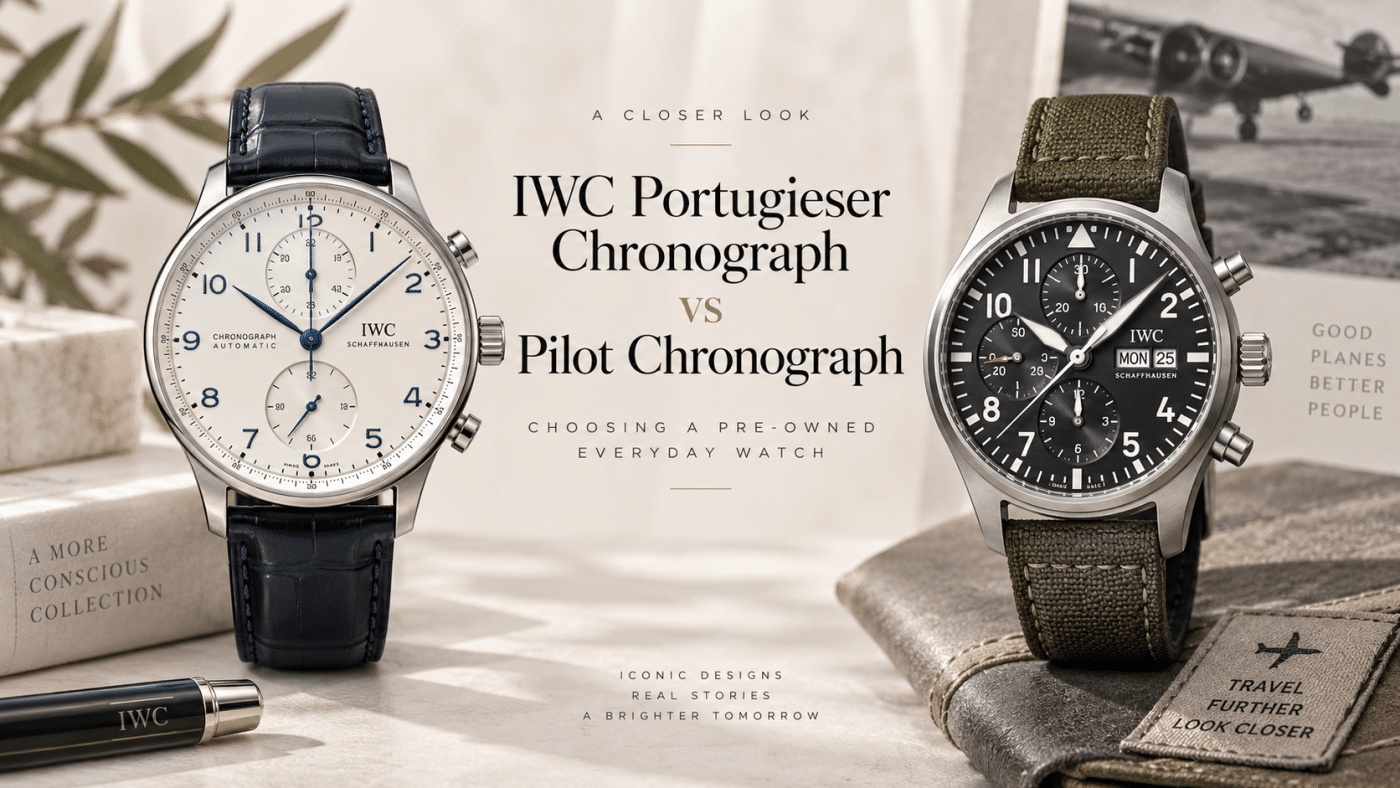
When collectors enter the pre-owned market searching for an everyday luxury chronograph from Schaffhausen, two iconic pillars dominate the conversation: the IWC Portugieser Chronograph and the IWC Pilot’s Watch Chronograph. While both hail from the same storied manufacture and frequently compete within an overlapping pre-owned price bracket of $5,500 to $7,500, they represent fundamentally opposite watchmaking philosophies.
The Portugieser is a maritime deck-watch descendant shaped into a tailored dress chronograph with pure symmetry and razor-thin bezels. The Pilot Chronograph is an uncompromising flight instrument born from cockpit utility, featuring heavy anti-magnetic shielding, bold sword hands, and day-date practicality. In this comparative buyer’s guide, we break down case ergonomics, movement generations, day-to-day durability, and pre-owned inspection checkpoints using verified examples from the Luxury Watches USA pre-owned IWC collection.
Design Philosophy: Marine Deck Chronometer vs. Cockpit Instrument
To understand why these watches wear and feel so distinct, it helps to examine their design heritage:
- IWC Portugieser Chronograph (Origins & Aesthetics): Originating in the late 1930s when two Portuguese merchants commissioned wristwatches with the precision of marine deck chronometers, the modern Portugieser Chronograph (introduced as Ref. 3714 in 1998) is widely celebrated as one of the most balanced chronograph dial layouts in horological history. It features vertical sub-dials at 12 and 6 o’clock, elegant feuille (leaf) hands, embossed Arabic numerals, and an ultra-slender bezel that allows the dial to occupy nearly the entire diameter of the case.
- IWC Pilot’s Watch Chronograph (Origins & Aesthetics): Tracing its bloodline to the historic Mark XI military aviator watches of 1948 and the Fliegerchronograph Ref. 3740/3706 of the 1990s, the Pilot Chronograph is engineered around instantaneous legibility under challenging conditions. It features matte or deep sunburst dials, oversized Arabic numerals coated with luminescent material, broad instrument hands, and an orientation triangle flanked by two dots at 12 o’clock.


Case Dimensions, Wrist Ergonomics, and the “Thickness Factor”
On paper, both watches seem closely sized in diameter—approximately 41 mm for the Portugieser and 41 mm to 43 mm for the Pilot Chronograph. However, on the wrist, they wear entirely differently due to case height and bezel geometry.
1. Case Thickness and Cuff Clearance
Case thickness is the single most critical differentiator for daily wear:
- Portugieser Chronograph: Measures 12.6 mm thick in the classic IW3714 reference and 13.0 mm in the modern IW3716 reference. Its sloping case flanks, dished sapphire crystal, and absence of an internal iron cage allow it to slide effortlessly beneath a tailored dress shirt cuff, jacket, or sweater sleeve.
- Pilot’s Watch Chronograph IW3777 (43 mm): Measures a substantial 15.4 mm in thickness. Much of this height stems from the internal soft-iron inner case engineered to shield the movement against magnetic fields, paired with a flat, muscular bezel and screw-down caseback. It sits tall on the wrist, making it much more suited to short sleeves, casual shirts, or leather jackets.
- Modern Pilot’s Watch Chronograph 41 (IW3881): Slimmed down to 14.5 mm, offering a more balanced profile while retaining robust wrist presence.
2. Dial Opening vs. Bezel Proportions
Because the Portugieser has virtually no outer bezel, its dial opening is unusually wide (approximately 38 mm across). This creates an optical illusion: the Portugieser appears larger than its 40.9 mm case would suggest, but its gentle lug downward curvature hugs wrists as small as 6.25 inches comfortably.
Conversely, the Pilot Chronograph features a broader brushed bezel and thicker case walls. While the 43 mm IW3777 requires a wrist size of at least 6.75 inches for optimal balance, the high visual contrast and purposeful tool aesthetics give it an athletic, masculine stance that few luxury chronographs can match.


Movement Generations: Valjoux/ETA Workhorses vs. Modern In-House Calibres
When shopping for pre-owned IWC chronographs, understanding the movement evolution inside each line is essential for evaluating long-term maintenance costs and mechanical prestige.
Portugieser Chronograph Movement Evolution
- Calibre 79350 (Reference IW3714, ~1998–2020): Built upon an extensively customized ETA/Valjoux 7750 architecture. IWC stripped out the day and date mechanisms, repositioned the running seconds to 6 o’clock, and replaced critical components (including the escapement and balance assembly) with proprietary Schaffhausen parts. Operating at 28,800 vph with a 44-hour power reserve and 31 jewels, this movement is legendary for its rock-solid reliability. A major advantage on the secondary market: any master watchmaker can service an IW3714 without requiring specialized manufacture tooling.
- In-House Calibre 69355 (Reference IW3716, 2020–Present): A true manufacture column-wheel chronograph developed under the Richemont group. It features 27 jewels, 28,800 vph, a 46-hour power reserve, bidirectional pawl-winding, and a sapphire crystal exhibition caseback that showcases circular Geneva striping and skeletonized rotor finishing.
Pilot’s Watch Chronograph Movement Evolution
- Calibre 79320 (Reference IW3777, ~2012–2021): Powered by a modified Valjoux 7750 retaining the iconic horizontal three-subdial layout (12-hour counter at 6, small hacking seconds at 9, 30-minute counter at 12) along with day and date displays at 3 o’clock. Housed within a soft-iron inner case, it provides exceptional resistance to magnetic radiation from flight decks and everyday electronics.
- In-House Calibre 69385 (Reference IW3881, 2021–Present): Column-wheel chronograph architecture incorporating day and date complications, a 46-hour power reserve, and a sapphire display back with 100 m water resistance (dropping the internal magnetic cage in exchange for modern silicon resistance and visual transparency).
Water Resistance and Everyday Durability
Daily wearability involves more than just how a watch looks with a suit or jeans; it requires resilience against moisture, accidents, and magnetic fields:
- Portugieser Chronograph: Features a water-resistance rating of 3 bar (30 meters / 100 feet) with non-screw-down pushers and a standard push-pull crown. While fully protected against accidental splashes, washing hands, or rain, it is strictly not suitable for swimming, showering, or aquatic sports. It is a dry-land luxury timepiece best preserved on its factory alligator strap.
- Pilot’s Watch Chronograph: Classic references like the IW3777 feature a screw-down crown and a water-resistance rating of 6 bar (60 meters / 200 feet). Newer 41 mm references (IW3881) elevate this to 10 bar (100 meters / 330 feet). Paired with its sapphire crystal secured against drops in air pressure and anti-magnetic inner shield, the Pilot Chronograph can comfortably handle swimming, heavy rain, travel, and active weekend pursuits.
Pre-Owned Market Comparison: Live LWUSA Catalog Snapshot
The following pre-owned IWC references illustrate the real-world choices and price overlap available right now at Luxury Watches USA. All prices reflect verified live catalog inventory at the time of publication:
| Model & Reference | Listed Price | Key Specifications | Best Suited For |
|---|---|---|---|
| IWC Portugieser Chronograph IW371446 | $6,600 | 40.9 mm steel case, 12.6 mm thick, silver dial, applied blued Arabic numerals & hands, Calibre 79350, blue alligator strap. | Business, corporate, and smart casual settings; purists wanting the definitive Portugieser dial. |
| IWC Portugieser Chronograph IW371447 | $6,600 | 40.9 mm steel case, 12.6 mm thick, deep black dial, rhodium-plated numerals & hands, Calibre 79350, black alligator strap. | Formal evening wear and stealth luxury; high contrast with a monochrome, architectural profile. |
| IWC Pilot Chronograph “Le Petit Prince” IW377714 | $6,592 | 43 mm steel case, 15.4 mm thick, sunburst midnight blue dial, day-date, Calibre 79320, soft-iron cage, Santoni brown calfskin strap. | Everyday versatile sports watch; collectors seeking vibrant blue dials and pilot heritage. |
| IWC Pilot Chronograph TOP GUN SFTI Ceramic IW389104 | $11,495 | 44.5 mm matte black zirconium oxide ceramic, titanium caseback & pushers, in-house Calibre 69380, green textile strap. | Tactical aviation enthusiasts wanting scratch-proof ceramic engineering and military provenance. |
Note: Listed prices and stock levels reflect active inventory at time of writing. Pre-owned inventory is one-of-a-kind; please contact our client specialists to confirm availability or request detailed macro photography.
Important Clarification: The Pilot Chronograph vs. The Big Pilot
When researching IWC aviator models, buyers frequently confuse the Pilot’s Watch Chronograph with the legendary IWC Big Pilot. It is vital to understand that these belong to entirely different watch categories:
- The Big Pilot (e.g., Ref. 5009, 5010) is an oversized (46.2 mm), time-only or annual calendar watch with an iconic conical onion crown, twin-barrel movement (Calibre 51111 / 52110) offering an immense 7-day power reserve, and a price point generally starting at $8,500 to $13,000+ pre-owned. It is an imposing historical tribute designed specifically for large wrists.
- The Pilot’s Watch Chronograph (Ref. 3777, 3881) is a multi-function stop-seconds instrument sized at 41 mm to 43 mm with dual pushers, day-date display, and an accessible $5,500 to $7,500 pre-owned price range, making it a far more practical everyday candidate. For deeper reading on IWC aviator instruments, explore our guide on IWC pilot watches, German engineering, and Swiss craftsmanship.
Pre-Owned Buying Checklist: What to Inspect Before You Buy
When investing in a pre-owned IWC chronograph, inspecting mechanical health and physical provenance ensures you receive maximum enjoyment and long-term value. Always verify the following six factors:
- Chronograph Pusher Engagement and Reset: Press the top pusher at 2 o’clock to start the timer, stop it after 45 seconds, and press the bottom pusher at 4 o’clock to reset. The action should feel crisp and tactile with no mushy resistance. The central chronograph seconds hand and the minute counter must snap back instantaneously to dead-center 12 o’clock without deviation.
- Case Polishing and Bezel Bevels: The Portugieser features very narrow, sharply defined polished bezel lips and brushed case sides. Over-polishing rounds off these razor-sharp edges and flattens lug profiles. Examine high-resolution photos to ensure factory geometry remains intact.
- Strap Condition and Replacement Costs: Many pre-owned Portugieser models feature genuine alligator leather straps, while Pilot Chronographs often come equipped with calfskin straps crafted by Italian shoemaker Santoni. Authentic IWC replacement leather straps with OEM deployant clasps retail between $350 and $550. Factor the strap’s wear and lining condition into your overall purchase budget.
- Crown Function and Threading: On Pilot Chronograph models (IW3777), inspect the screw-down crown threads. The crown should engage smoothly with 2.5 to 3 complete turns before tightening flush against the case. On Portugieser models, verify that the push-pull crown winds smoothly without gritty gear friction.
- Presence of Box, Papers, and Service Records: A complete collector set (original wooden box, warranty card with matching serial number, and operating instructions) adds roughly $400 to $800 in value. A documented service within the last two to three years provides immediate peace of mind.
- Timegrapher Metrics: Request timegrapher results from the dealer. A healthy IWC automatic calibre should produce an amplitude reading between 275° and 315° with a beat error under 0.4 ms and daily variance within ±4 to 6 seconds per day.
For more advice on selecting high-end watches tailored to your career and daily routine, consult our article on luxury watches for specific professions.
The Verdict: Which Schaffhausen Icon Belongs on Your Wrist?
Both watches are universally respected masterworks of Swiss horology that hold stable long-term value on the secondary market. Your choice comes down to how your days unfold:
- Select the IWC Portugieser Chronograph if:
- Your regular wardrobe consists of suits, dress shirts, blazers, or refined knitwear.
- You value a dressier, visually serene dial with classical leaf hands and vertical chronograph symmetry.
- You prioritize a svelte 12.6 mm case thickness that slides under cuffs without catching.
- Select the IWC Pilot’s Watch Chronograph if:
- Your lifestyle demands a versatile sports watch that handles rain, swimming, and active travel.
- You rely on a day-date complication for daily desk productivity.
- You prefer high-contrast luminescent flight instruments and a bold, muscular wrist presence.
Frequently Asked Questions
Is the IWC Portugieser Chronograph too dressy for casual everyday wear?
Not at all. While the Portugieser was originally paired exclusively with glossy black or dark blue alligator leather, modern collectors frequently pair references like the IW371446 with matte calfskin, suede, or custom Milanese mesh bracelets. On a textured tan or grey leather strap, the Portugieser effortlessly transitions to polo shirts and denim.
Can you swim with an IWC Pilot Chronograph?
Yes, provided the watch has been pressure-tested within the past 12 months and the screw-down crown is fully secured. The IW3777 offers 60 meters (6 bar) of water resistance, while newer IW3881 models provide 100 meters (10 bar). However, ensure you swap out the factory leather strap for an OEM rubber or NATO textile strap before entering the water.
What is the difference between IWC reference 3714 and 3716?
The Reference 3714 (produced until 2020) is powered by Calibre 79350 (modified ETA/Valjoux base) with a solid steel caseback and measures 12.6 mm thick. The Reference 3716 (introduced in 2020) features IWC’s in-house manufacture Calibre 69355 with a sapphire exhibition caseback, column-wheel actuation, and measures slightly thicker at 13.0 mm.
Do IWC chronographs hold their value pre-owned?
When purchased pre-owned at fair market prices, both the Portugieser Chronograph and Pilot Chronograph demonstrate strong value retention. Because the initial retail depreciation has already occurred, core references like the IW371446, IW371447, and IW377714 remain liquid, stable assets backed by persistent global collector demand.
 Free Shipping for all orders