

















Blog, Rolex
The 2027 Rolex Submariner Speculation: Will We See a Titanium ‘No-Date’ or New Green Ceramic Hue?

Sep
Quick Answer: An RLX Titanium Submariner No-Date is technically credible: Rolex already machines grade 5 titanium for the Yacht-Master 42 and Deepsea Challenge, while the 124060 supplies the ideal time-only architecture. Green may be easier to evolve again, following Kermit, Hulk, Starbucks, and the 2023 bezel-shade revision into 2027 without changing proportions.
Rolex has announced neither a titanium Submariner nor a new 2027 green bezel. As of September 2026, the current Submariner 124060 remains an Oystersteel model, while RLX titanium is established in the Yacht-Master 42 and Deepsea Challenge. So both proposed Submariner changes remain speculation rather than leaked product information.
The RLX Titanium Argument: Why a 100-Gram Submariner Is the Logical Next Step

The material case is strong. Rolex defines RLX titanium as a grade 5 titanium alloy chosen for low weight, mechanical strength and corrosion resistance. It can receive both satin and polished finishes. The 42 mm Yacht-Master 226627 proves Rolex can apply the alloy to a comparatively conventional sports-watch case and Oyster bracelet, while the 50 mm Deepsea Challenge demonstrates what it can do inside an extreme diving architecture.
The Deepsea Challenge is particularly relevant. It is waterproof to an extraordinary 11,000 metres, yet Rolex says its RLX titanium construction makes it 30 percent lighter than the 904L-steel experimental watch that inspired it. That is not merely a cosmetic material swap. Rolex has already engineered titanium around serious pressure resistance, bracelet construction and professional-watch durability.
That makes the Submariner the obvious missing middle.
The current 124060 is 41 mm, water-resistant to 300 metres, powered by calibre 3230 and built around a simple three-hand architecture with approximately 70 hours of power reserve. A titanium derivative would not demand an entirely new complication or movement. The engineering challenge would instead concentrate on case construction, crown interfaces, bracelet components, finishing, tolerances and waterproof validation.
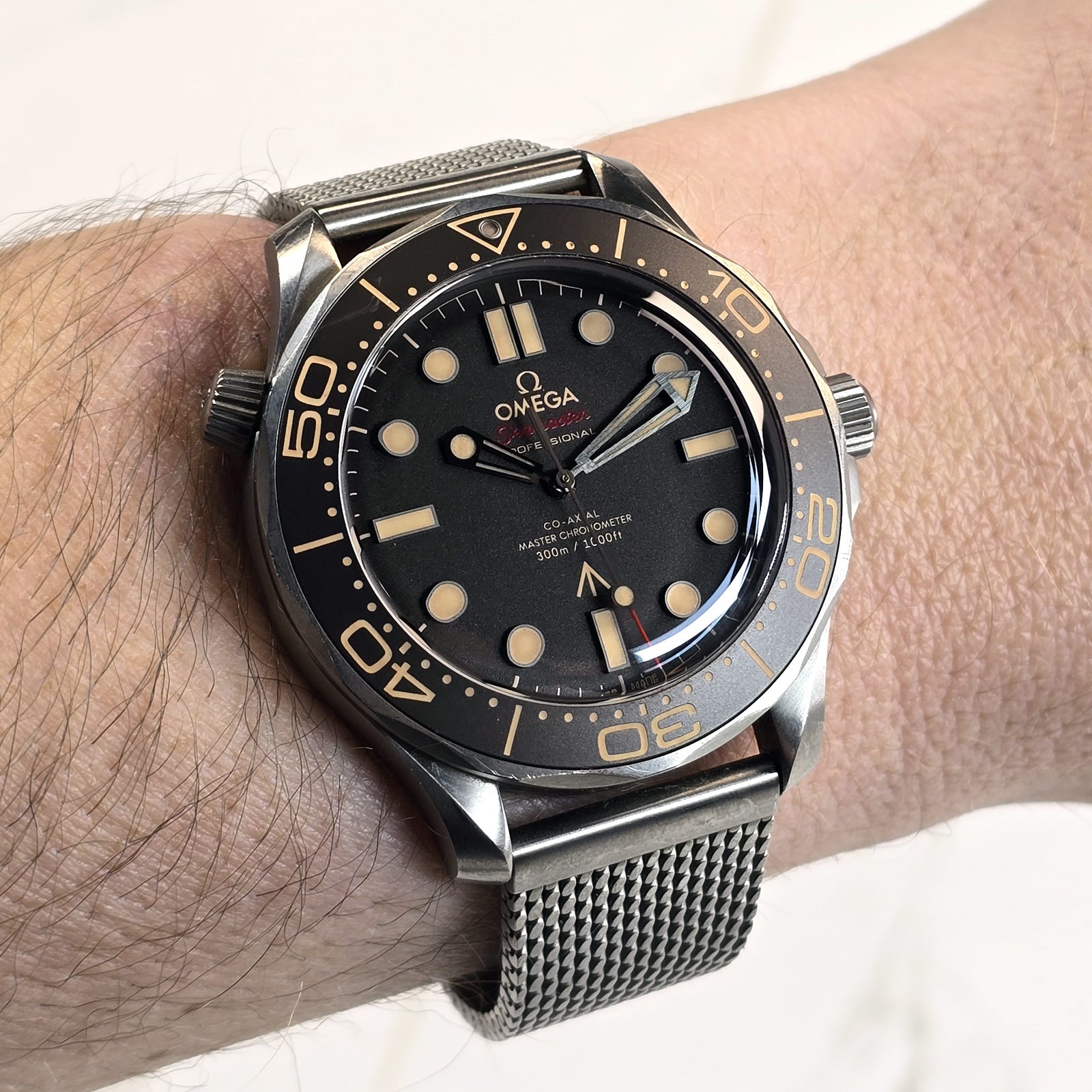
“100 grams” should be treated as an engineering target, not some mysterious Rolex leak passed between collectors in a Geneva basement. Omega’s 42 mm Seamaster Diver 300M 007 Edition weighs approximately 93 grams on its titanium bracelet and remains water-resistant to 300 metres. It uses Grade 2 rather than Rolex’s Grade 5 alloy, but it proves how dramatically titanium can alter the wearing experience of a full-bracelet luxury diver.
A 41 mm RLX Titanium Submariner somewhere around the 100-gram neighborhood is therefore technically believable.
The strongest counterargument is not engineering. It is product strategy. Oystersteel is fundamental to the Submariner’s identity. Rolex may prefer keeping RLX titanium for watches whose identities already revolve around unusual engineering or reduced weight.
Technically plausible does not mean commercially inevitable.
The Evolution of Green: Will Rolex Introduce a ‘Forest Green’ or ‘British Racing Green’ Ceramic Bezel?


Green is no longer a one-off Submariner experiment. It has become a lineage.
The 2003 reference 16610LV “Kermit,” created for the Submariner’s 50th anniversary, paired a black dial with the first green bezel in Submariner history. That insert was anodized aluminum rather than ceramic. Rolex subsequently moved the Submariner Date to Cerachrom ceramic, and the 116610LV “Hulk” pushed the theme much further with both a green ceramic bezel and green dial.
Then came the 41 mm 126610LV in 2020, restoring the black-dial/green-bezel formula associated with the Kermit.
There is an important correction to one version of the current rumor. Collector terminology generally identifies the 2020-to-mid-2023 MK1 bezel as the darker, cooler, forest-leaning green. The later MK2 is brighter, warmer and somewhat closer to the character of certain Kermit inserts.
Rolex never officially marketed these as “MK1” and “MK2,” nor did the company assign a new reference number to the revised shade. The terminology comes from collectors and dealers comparing production examples.
That makes the 2027 color theory more interesting.
Rolex would not necessarily need to create an entirely new Submariner reference. A third ceramic formulation could push the bezel toward a much deeper forest green, a darker British Racing Green, or merely alter the green’s saturation and undertone.
Ceramic also makes subtle color engineering unusually effective because the apparent hue changes substantially with illumination. A darker insert could look nearly black indoors, then become unmistakably green in strong daylight.
From a product-risk perspective, this is far easier than building an RLX Titanium Submariner. The movement, Oyster bracelet, case architecture and established LV identity could remain intact.
If Rolex wants a clearly visible 2027 update without rewriting the Submariner formula, the bezel is arguably the cleanest lever available.
The No-Date Purity Debate: Why the Ref. 124060 Is the Perfect Canvas for Innovation
If Rolex ever introduces a titanium Submariner, the 124060 is the cleanest canvas.
Its black dial is symmetrical. There is no date aperture and therefore no Cyclops magnifier interrupting the crystal. Calibre 3230 handles hours, minutes, seconds and stop-seconds, with roughly 70 hours of power reserve. The watch combines a 41 mm Oystersteel case with 300-metre water resistance, an Oysterlock clasp and Rolex’s Glidelock adjustment system.
That simplicity would allow the material itself to become the innovation.
Imagine the familiar 124060 geometry rendered in the darker grey character of RLX titanium: strong satin grain across the bracelet and case, carefully polished chamfers around the lugs, a black Cerachrom bezel and nothing added to the dial.
No new complication. No oversized case. No decorative excuse required.
There is historical logic behind that approach too. Rolex launched the Submariner in 1953 as a no-date diver; the Submariner Date did not arrive until 1969. The original model was rated to 100 metres, while the modern non-date line eventually reached its present 300-metre rating in 1989.
A titanium No-Date could therefore be technically radical while remaining philosophically conservative: change the metallurgy, leave the idea alone.
Historical Timeline & Future Speculation Matrix: Rolex Submariner Evolution (1953 to 2027)
| Year | Reference / Development | What Changed | What It Suggests for 2027 |
|---|---|---|---|
| 1953 | Early Submariner | First Rolex diver rated to 100 m. | Tool-watch function remains the foundation |
| 1969 | Submariner Date | Date complication joins the family. | No-Date and Date can coexist |
| 1989 | Submariner | Non-date Submariner reaches 300 m. | Engineering can evolve without abandoning the concept |
| 2003 | 16610LV “Kermit” | First green Submariner bezel, using anodized aluminum. | Rolex uses color to mark major evolution |
| 2010 | 116610LV “Hulk” | Green Cerachrom era and full-green aesthetic. | Ceramic expands the color vocabulary |
| 2020 | 124060 / 126610 generation | 41 mm architecture and new-generation 3230/3235 movements. | Mature platform for future material experiments |
| 2023 | 126610LV MK2, collector terminology | Brighter green bezel documented without a reference change. | Rolex can make subtle visual revisions quietly |
| 2027? | Speculation only | RLX Titanium No-Date, revised green ceramic, or both | Technically credible, completely unconfirmed |
The pattern matters. Rolex generally evolves the Submariner in deliberate increments rather than reinventing it every product cycle.
That is why a titanium 124060-style model would be a genuinely major event, while another adjustment to the LV bezel could arrive almost quietly.
5 Frequently Asked Questions for Submariner Collectors
1. Has Rolex confirmed a titanium Submariner for 2027?
No. As of September 2026, Rolex publicly lists the 124060 in Oystersteel. RLX titanium is used elsewhere in the Professional family, but there is no announced titanium Submariner.
2. Would RLX titanium make the Submariner less durable?
Not inherently. Rolex selected its grade 5 alloy specifically for lightness, mechanical strength and resistance to deformation and corrosion. What remains unknown is how Rolex would engineer and finish a Submariner bracelet and case around it.
3. Why would Rolex choose the No-Date first?
Because the 124060 is mechanically and visually the simplest current Submariner. A material change could stand on its own without being mixed with a new complication. That is product-design logic, not evidence of Rolex’s actual plans.
4. Is a new green bezel easier to imagine than titanium?
From an engineering standpoint, yes. Collector documentation already records a color shift within the current 126610LV generation without a reference-number change. Another evolution would require much less disruption than creating a titanium case and bracelet.
5. Would titanium have to replace the Oystersteel 124060?
No. Rolex could theoretically position an RLX Titanium version alongside the classic steel No-Date, just as different materials coexist elsewhere in its Professional catalogue.
Shop Certified Pre-Owned Rolex Submariner Models at Luxury Watches USA
The 2027 watch remains hypothetical. The references behind the argument do not.
Luxury Watches USA currently lists steel examples spanning the 124060 No-Date, 126610LV Starbucks, discontinued 116610LV Hulk and 16610LV Kermit, making it possible to compare multiple generations of the same Submariner design language rather than waiting for rumor season to manufacture another imaginary reference number.
Shop Rolex Watches at Luxury Watches USA
Shop Rolex Submariner Watches at Luxury Watches USA
Buy today’s Submariner for what it is, not because of a rumor about what Rolex may unveil next. If 2027 delivers RLX titanium, a third-generation green Cerachrom shade, or both, it will matter precisely because the Submariner changes so rarely.
 Free Shipping for all orders