


















May
The Rolex Yacht-Master II has always been the most technically complex watch in the Rolex lineup — a programmable countdown timer engineered for professional yacht racing. But the 2026 redesign takes it somewhere no modern Rolex has ever gone: the countdown hands now sweep counter-clockwise. It is not a gimmick. It is a fundamental mechanical re-architecture of the entire regatta timing system, and it has already sent the secondary market into a frenzy. Early secondary market data shows steel references trading at $8,000–$12,000 above retail within weeks of availability.
| Browse our fully authenticated Rolex inventory — sports models, complications, and the latest 2026 references available for immediate acquisition. |
Why Counter-Clockwise? The Engineering Logic
Standard regatta timers — including all previous Yacht-Master II generations — count down on a clockwise arc. Your eye tracks the hand moving forward even as time moves backward, requiring a micro-second of cognitive translation that becomes critical in the final moments before a starting gun. Rolex’s solution is deceptively elegant: match the physical direction of the hand sweep to the natural direction of a countdown. The hand sweeps backward because time is moving backward. The mental load drops to zero.
To achieve this, Rolex completely rebuilt the regatta timing module — the mechanical layer sitting above the base movement that governs the programmable 5-to-10 minute countdown. The new architecture features a redesigned column wheel and vertical clutch system with inverted torque geometry. The engagement is completely smooth with no jump on activation — a persistent minor criticism of previous-generation Yacht-Master IIs that has now been fully resolved.
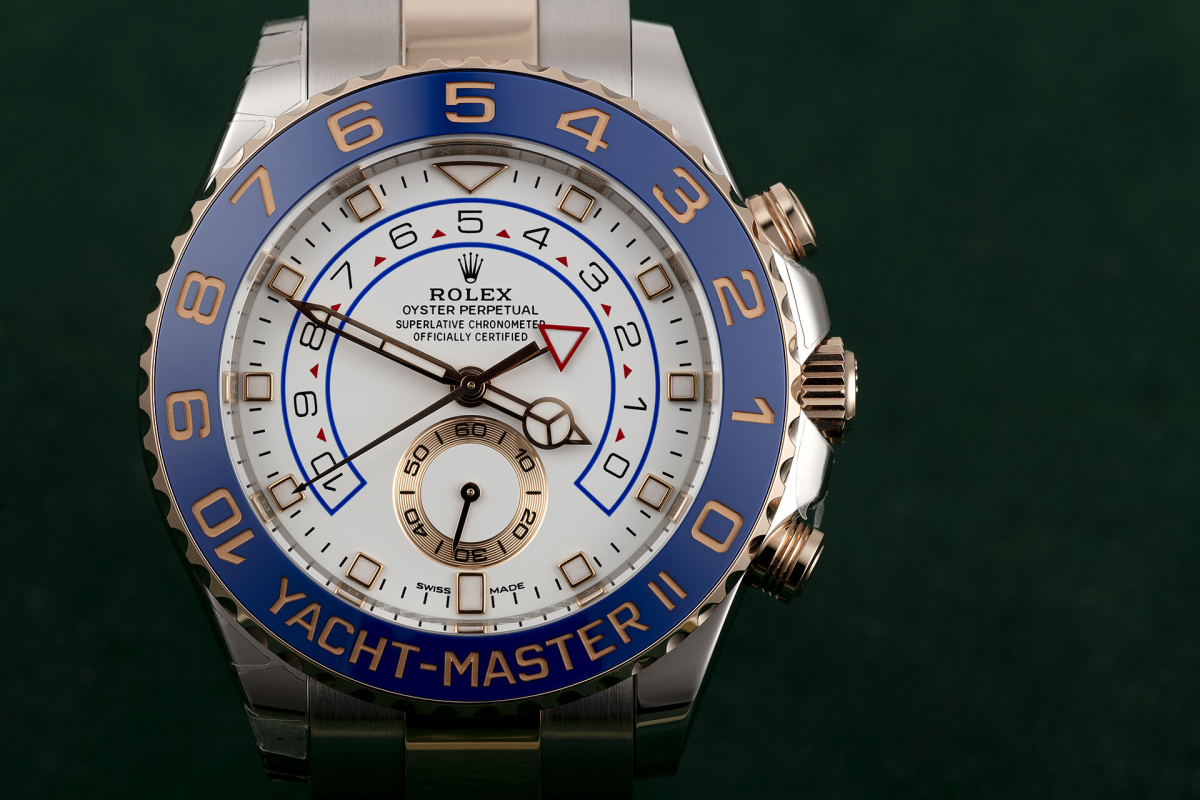
Specifications: 2026 Yacht-Master II
| Specification | Detail |
|---|---|
| Case Diameter | 44mm (refined profile, reduced lug height) |
| Material | Oystersteel / Everose Gold / Oystersteel + Everose |
| Movement | Cal. 4161 (revised) — redesigned regatta module |
| Power Reserve | 72 hours |
| Countdown Direction | Counter-clockwise (industry first for Rolex) |
| Regatta Timer Range | Programmable 5 to 10 minutes |
| Bezel | Ring Command, blue Cerachrom ceramic |
| Water Resistance | 100 meters |
| Bracelet | Oysterlock with improved Easylink micro-adjustment |
| MSRP (Steel) | ~$21,900 USD (estimated at retail launch) |
Reworked Movement: What Changed Inside
The base movement remains derived from Caliber 4161, the same architecture that powered previous Yacht-Master II generations. But the regatta timing module on top of it has been fundamentally redesigned. Upgraded shock-resistance components throughout the escapement, a new anti-magnetic alloy in the lever and escape wheel, and a more efficient gear train mean the power reserve has been extended from 70 to 72 hours with the timer active. The column wheel — previously a source of the occasional activation hesitation — has been replaced with a new precision-machined component with tighter tolerances.
For collectors, the significance of a revised movement architecture cannot be overstated. Rolex assigns new reference numbers when internal specifications change materially. The 2026 redesign qualifies. That means early production examples of the new counter-clockwise reference will be documented separately in future Rolex catalogs and auction databases — the same dynamic that has driven massive premiums for transition-year references throughout Rolex history.
| Have a previous-generation Yacht-Master II or another Rolex to sell? We buy authenticated Rolex watches at competitive market rates with same-day cash offers. |

Design Changes: Bezel, Case, Bracelet
The blue Cerachrom Ring Command bezel has been re-engraved with sharper, deeper numerals and a platinum PVD fill with stronger contrast — noticeably more legible against the ceramic than the previous generation. The 44mm case dimensions are unchanged, but Rolex has reduced the lug height slightly, improving how the watch sits on a broader range of wrist sizes. The overall result is a watch that wears closer to a 42mm than a 44mm in terms of wrist presence despite identical diameter.
The Oysterlock bracelet has been upgraded with a new clasp mechanism — the Easylink micro-adjustment system now operates in finer increments with a more positive click engagement. This is the same bracelet improvement first introduced on the 2023 Submariner update, now extended across the sports watch lineup.
Secondary Market Pricing and Investment Case
The previous-generation Yacht-Master II (Ref. 116680, steel) had settled at near-retail secondary market pricing — roughly $17,000–$19,000 against an MSRP of around $18,100. The new counter-clockwise reference has reset that entirely. Within the first weeks of availability, authenticated examples of the new reference were trading at $28,000–$32,000 in early secondary market transactions — a premium of $8,000–$12,000 above estimated retail.
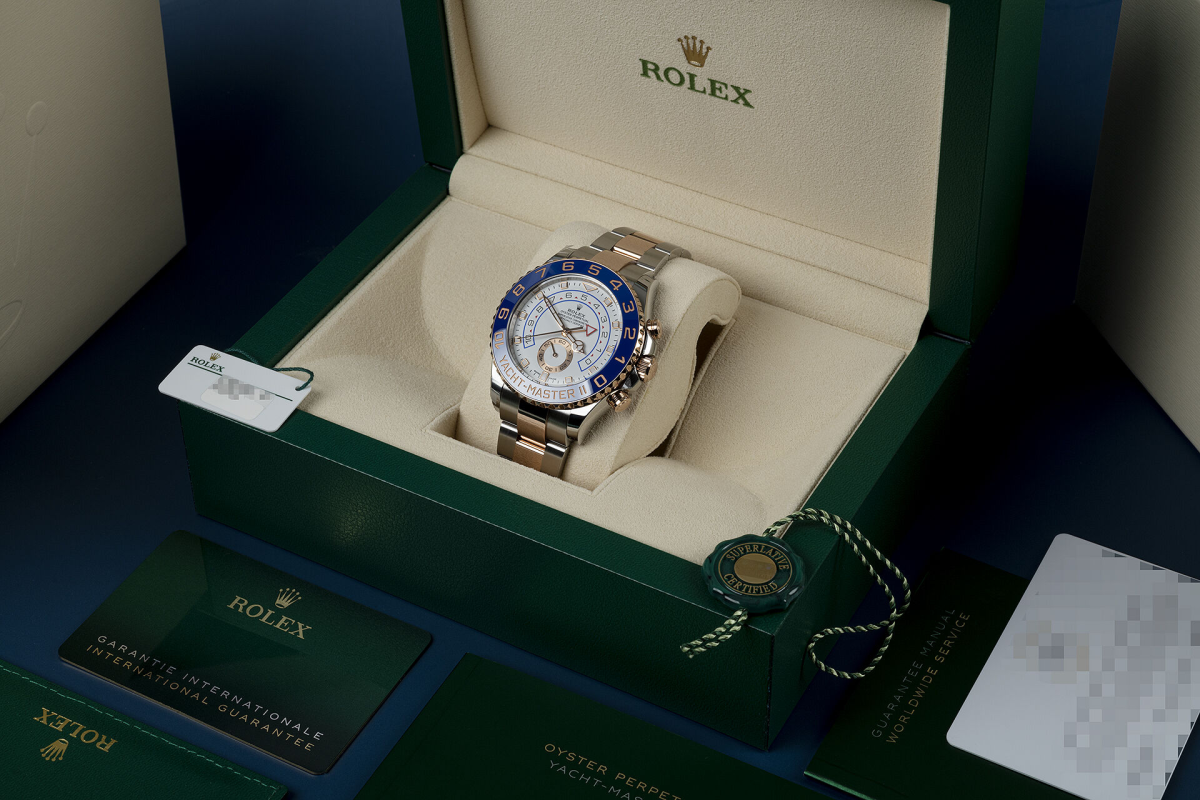
The demand dynamics here differ from a standard new-Rolex premium. Collectors are not simply paying a novelty tax. They are pricing in: (1) the extreme rarity of a fundamentally unusual mechanical decision from Rolex, (2) the new-reference status and its long-term catalog significance, and (3) the historical pattern of Rolex “firsts” — first left-handed case, first colored sapphire, first ceramic bezel — becoming major collector benchmarks over 10–20 year periods.
| Reference / Variant | Estimated MSRP | Early Secondary Market | Premium Over Retail |
|---|---|---|---|
| Steel (new CCW ref.) | ~$21,900 | $28,000–$32,000 | +$8,000–$10,000 |
| Everose Gold | ~$37,900 | $46,000–$52,000 | +$8,000–$14,000 |
| Two-Tone (Rolesor) | ~$28,500 | $35,000–$40,000 | +$6,500–$11,500 |
| Previous Gen. 116680 (steel) | ~$18,100 | $17,000–$19,500 | Near parity |
| Interested in acquiring a 2026 Rolex Yacht-Master II or another sports Rolex? Our specialists can advise on availability and market positioning. |
Who Should Buy It
For the working collector: The new Yacht-Master II is the most technically interesting Rolex available in 2026. No other in-production Rolex offers a comparable mechanical novelty. If your collection needs a conversation piece that has genuine horological substance behind it, this is it.
For the investor: Early production examples of mechanically significant Rolex references have a documented history of appreciating aggressively as market recognition builds. The Milgauss, after its 2023 discontinuation, jumped 20–30% in under two years. The 116610LV Submariner “Starbucks” commanded enormous premiums in its first reference years. The counter-clockwise Yacht-Master II has the same profile: genuinely unusual, finite early supply, and a clear mechanical story that translates in any market.
For the regatta sailor: This is, first and foremost, a professional tool watch — and the new countdown logic is a genuine functional improvement. The counter-clockwise sweep is more intuitive under race conditions once the initial adjustment period passes, typically within one or two practice sessions.

FAQ
The 2026 redesign introduces counter-clockwise hands during the regatta countdown — a fundamental change to the mechanical architecture of the timing module. Additional changes include a redesigned column wheel with tighter tolerances, extended 72-hour power reserve (up from 70), a sharper Cerachrom bezel with deeper engraving, improved Easylink bracelet clasp, and a refined case profile with reduced lug height.
Rolex redesigned the regatta countdown logic so the hand sweep direction matches the cognitive experience of counting down. A counter-clockwise sweep feels instinctively backward — which is exactly what a countdown is. This eliminates the micro-second of mental translation required when watching a clockwise hand approach zero under race-day pressure.
Early secondary market data shows steel references trading at $28,000–$32,000, representing a premium of $8,000–$10,000 above estimated retail of approximately $21,900. Everose gold models are trading at $46,000–$52,000. These premiums reflect both novelty demand and collector recognition of the new reference’s long-term catalog significance.
Mechanically significant Rolex references with documented “firsts” — first colored sapphire, first ceramic bezel, first counter-clockwise movement — have historically shown strong long-term appreciation. Early production examples of the new reference carry the additional value of transition-year status, which auction databases track separately. The combination of genuine mechanical novelty and finite early supply creates a collector-favorable supply-demand dynamic.
The arrival of the 2026 redesign creates natural upgrade pressure in the market for previous-generation references. Pre-owned Ref. 116680 steel examples are currently trading near retail parity at $17,000–$19,500 — a favorable exit window before any softening from buyer migration to the new reference. We purchase authenticated Yacht-Master II pieces at competitive market rates with same-day offers.
 Free Shipping for all orders