

















Aug
The Breitling Navitimer stands as the definitive pilot’s chronograph — a masterpiece of horological engineering that has commanded respect in cockpits and boardrooms for over seven decades. Since its debut in 1952, this iconic timepiece has transcended its utilitarian origins to become one of the most coveted luxury chronographs in the world, representing the perfect marriage of Swiss precision, aviation heritage, and timeless design sophistication.

Origins: Born for the Cockpit in 1952
The Navitimer’s story begins in 1952 when Willy Breitling was approached by the Aircraft Owners and Pilots Association (AOPA) — the world’s largest pilots’ organization — to create an exclusive chronograph for its members. Drawing inspiration from Breitling’s successful 1942 Chronomat, Willy adapted the original logarithmic slide rule for aviation purposes, integrating it into a rotating bezel surrounded by small beads for easy manipulation with gloved hands.
The name “Navitimer” — a portmanteau of “navigation” and “timer” — perfectly captured the essence of this wrist-worn flight computer.
The original Navitimer Reference 806 was exclusively distributed to AOPA members, featuring the distinctive AOPA wings logo at 12 o’clock rather than Breitling branding. At 41mm, the case was remarkably large for the 1950s, ensuring maximum legibility in challenging cockpit conditions. Oversized Arabic numerals coated with radium provided excellent contrast against the black dial, while the slide rule bezel enabled pilots to calculate average speed, distance traveled, fuel consumption, and rate of climb or descent.
The watch’s adoption by aviation professionals was swift and comprehensive. Its significance was further cemented when NASA astronaut Scott Carpenter wore a specially modified 24-hour Navitimer into space during the Mercury-Atlas 7 mission in 1962 — making it the first Swiss chronograph worn in space.

Browse our authenticated Breitling Navitimer collection — vintage and modern references available.
Design: The World’s Most Complex Dial Explained
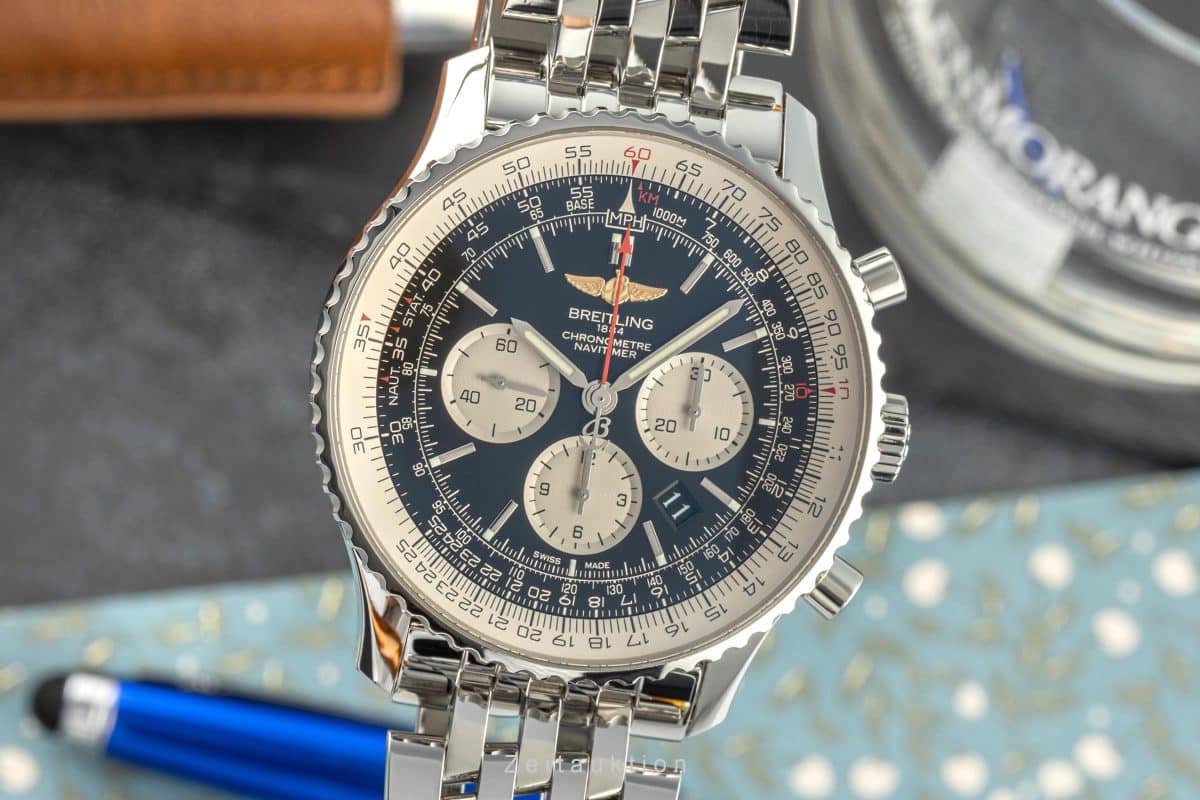
The Navitimer’s design philosophy represents the ultimate synthesis of form and function. Its signature slide rule bezel is a masterpiece of miniaturization — a bidirectional rotating outer scale working in conjunction with a fixed inner scale to enable complex mathematical calculations through logarithmic principles. The knurled edge design, featuring precisely machined beads, ensures secure operation even with gloved hands.
The tricompax dial layout places the 30-minute chronograph counter at 3 o’clock, the 12-hour recorder at 6 o’clock, and running seconds at 9 o’clock. What initially appears chaotic reveals itself as brilliantly organized functionality — maximizing readability while accommodating the numerous scales essential for aviation calculations.

Modern Navitimer achieves remarkable dial clarity through contrasting elements: black subdials against lighter main dial colors, polished and faceted indices with luminous tips, and a date window at 6 o’clock within the hour counter subdial.
The case measures 43mm diameter with a 49mm lug-to-lug measurement — substantial presence without overwhelming the wrist. The cambered sapphire crystal with anti-reflective coating on both sides enhances readability and creates an optical illusion of a more compact profile.

Movements: From Venus 178 to the In-House B01
The Navitimer’s mechanical evolution chronicles seven decades of chronograph technology advancement.
The earliest Navitimers were powered by the Venus 178 movement — a 17-jewel manual-wind caliber that became legendary in chronograph circles. Measuring 31mm in diameter with a 7.1mm height, it featured a column wheel mechanism delivering smooth chronograph operation and a 45-hour power reserve. During the late 1950s, Breitling transitioned to the Valjoux 72 before returning to the Venus 178 as its standard powerplant.
The 1969 introduction of Caliber 11, developed in partnership with other Swiss manufacturers, marked the Navitimer’s entry into the self-winding era — among the first automatic chronographs ever produced.

The true revolution came in 2009 with the in-house Caliber B01 — Breitling’s first completely self-developed movement. Technical specifications:
- 47 jewels, automatic winding
- Column wheel with vertical clutch — smooth chronograph hand movement, no jumping
- 28,800 vph for excellent timekeeping precision
- COSC chronometer certified — accuracy within -4/+6 seconds per day
- 70-hour power reserve — runs through an entire weekend when removed Friday

Current Models and Pricing

The core Navitimer B01 Chronograph 43 serves as the collection’s flagship, available in stainless steel from approximately $8,350 to $9,700 depending on strap or bracelet configuration. This model exemplifies the perfect balance of heritage design and modern refinement, powered by the prestigious in-house B01.
Size range: 35mm to 46mm. The 35mm and 38mm versions target refined aesthetics, often featuring diamond-set mother-of-pearl dials. The larger 46mm maintains the traditional bold presence aviation professionals prefer.
Material progression: – Stainless steel: $8,350–$9,700 — entry to the B01-powered collection – Two-tone steel and gold: Elevated luxury without full precious metal pricing – Full yellow or rose gold: $16,500+ — the collection’s apex of luxury
Dial options: Traditional black and silver now share space with sophisticated blue, green, and copper dials featuring sunburst finishing.
Special editions: The Navitimer Cosmonaute honoring Scott Carpenter’s space flight, AOPA commemoratives, and anniversary editions maintain collector interest and command premiums.

Explore the full Breitling collection — Navitimer, Chronomat, Superocean and more.
Collector Appeal and Investment Value
The Navitimer’s evolution from professional instrument to cultural icon represents one of watchmaking’s most successful transitions. Celebrity associations have significantly enhanced its cultural cachet: jazz legend Miles Davis, French singer Serge Gainsbourg, and Formula 1 champions Jim Clark and Graham Hill were early adopters. Contemporary wearers include John Travolta (a licensed airline pilot and Breitling ambassador), Leonardo DiCaprio, and Brad Pitt. Jerry Seinfeld’s consistent wearing of Breitlings throughout his sitcom’s nine-season run introduced the brand to millions of viewers in the 1990s.
Vintage market values: – Early AOPA Reference 806 models: $4,000–$12,000 depending on condition and provenance – 1954 “pre-806” models (produced for only one year): $14,000+ for pristine examples – Original documentation, matching numbers, and unrestored condition significantly impact valuation
Modern Navitimer investment reality: Modern references typically experience 10–40% depreciation from retail pricing in the first few years. However, vintage examples and limited editions — particularly the Cosmonaute and AOPA commemoratives — demonstrate stronger value retention and can maintain or exceed original purchase prices.
The Emergency and Cosmonaute variants, due to unique complications and historical significance, represent the best investment cases within the collection.
Selling your Breitling Navitimer? Get a competitive cash offer based on current secondary market data.
Frequently Asked Questions
The Breitling Navitimer is celebrated as the definitive pilot’s chronograph since 1952. Its signature slide rule bezel functions as an analog flight computer for aviation calculations including speed, distance, fuel consumption, and climb/descent rates. The watch gained historical significance when NASA astronaut Scott Carpenter wore it in space in 1962.
The rotating outer scale works with a fixed inner scale using logarithmic principles to perform calculations including average speed, distance traveled, fuel consumption, and rate of climb or descent. The knurled bead edge allows precise operation even with gloved hands in cockpit conditions.
Current flagship models use Breitling’s in-house Caliber B01 — a 47-jewel automatic chronograph with column wheel and vertical clutch, 28,800vph, COSC chronometer certification (accuracy within -4/+6 seconds per day), and a 70-hour power reserve.
The Navitimer B01 Chronograph 43 in stainless steel ranges from $8,350 to $9,700 depending on strap or bracelet. Two-tone models command intermediate pricing, while full gold versions exceed $16,500. Vintage Reference 806 examples sell for $4,000–$12,000, with rare 1954 pre-806 models reaching $14,000+.
Modern Navitimers typically depreciate 10–40% from retail. Vintage models and limited editions — especially early Reference 806, Cosmonaute, and AOPA commemoratives — demonstrate significantly stronger value retention and often appreciate. The key is buying the right reference: historically significant variants outperform standard production models.
Pilots, aviation enthusiasts, luxury watch collectors, and style-conscious professionals. Notable wearers include John Travolta (licensed pilot and Breitling ambassador), Leonardo DiCaprio, Brad Pitt, Miles Davis, and Serge Gainsbourg. Jerry Seinfeld’s nine seasons wearing Breitling helped bring the brand to mainstream audiences.
 Free Shipping for all orders