

















Aug
The Rolex Cosmograph Daytona is the most in-demand sports chronograph in the world. Steel models trade at 90–130% over retail on the grey market because authorized dealer allocations are nearly impossible to access for new buyers. Precious metal references — yellow gold, white gold, Everose — sit closer to retail and are far easier to find. This guide covers every current reference, what drives the pricing gap, and what to look for before you buy.
Few watches carry the Daytona’s combination of heritage and market demand. Born from Rolex’s formal partnership with the Daytona International Speedway in 1962 and refined over six decades, the Cosmograph Daytona has moved far beyond its roots as a racing chronograph. Today it functions simultaneously as a mechanical benchmark, a collector’s asset, and one of the clearest signals in luxury watches that demand and supply are still nowhere close to balance.

Browse available Daytona references — steel, gold, and pre-owned — currently in stock.
Origins and the Racing Connection
The Daytona’s genesis lies deep within motorsport’s golden age. In the 1930s, Sir Malcolm Campbell, the legendary “King of Speed,” forged an indelible connection between Rolex and motorsport excellence while setting numerous land speed records on Daytona Beach. Campbell’s exploits at Daytona Beach, where he broke the 300 MPH barrier in 1935 while wearing a Rolex Oyster, established the foundation for what would become one of watchmaking’s most celebrated partnerships.
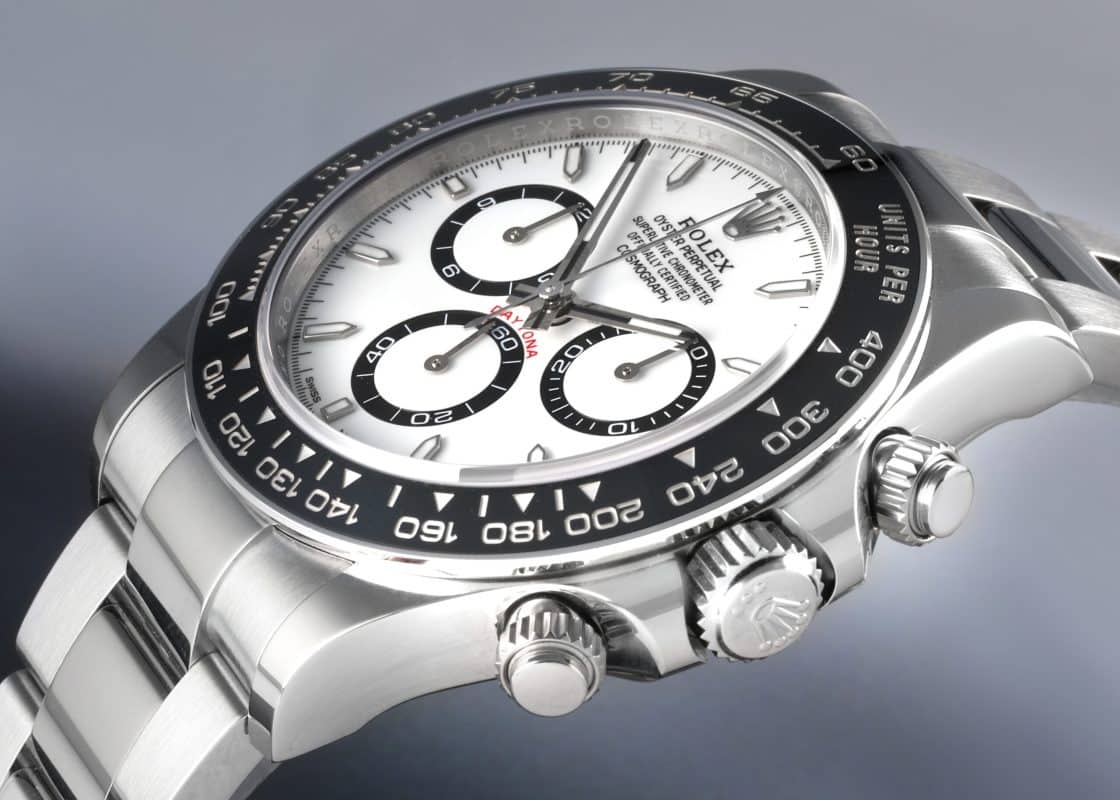
In 1962, Rolex formalized its relationship with American motorsport by becoming the official timekeeper of the Daytona International Speedway. The following year, in 1963, Rolex launched the first Cosmograph, initially marketed as the “Le Mans” before adopting the Daytona name in 1965. The watch was conceived specifically for professional racing drivers, featuring a tachymeter scale on the bezel that enables drivers to calculate average speeds up to 500 miles per hour — a crucial tool for lap timing and performance analysis.

Key References Every Buyer Should Know
Reference 126500LN (2023–present)
The current steel flagship. Features the Caliber 4131 movement with the Chronergy escapement and 72-hour power reserve. Available in white or black dial with ceramic Cerachrom bezel. Retail around $14,550. Secondary market trades at $26,000–$33,000 depending on condition and completeness.
Reference 116500LN (2016–2023)
The previous generation that introduced the ceramic bezel to the Daytona line. Still highly desirable with strong secondary market values. Runs Caliber 4130. If you find one in excellent condition with full set, it’s worth considering — values have remained strong even after the 126500LN introduction.
Reference 126518LN (Yellow Gold)
Retail around $38,200. Trades 5–15% above retail on the secondary market — significantly more accessible than steel. Available on Oyster bracelet or Oysterflex. Diamond-set hour markers and dial options including champagne and meteorite.
Reference 126506 (Platinum)
The exclusive ice-blue dial with chestnut ceramic bezel. Retail around $80,450. Trades above retail but the gap is narrower than steel. If you want a Daytona that gets noticed, this is it — the ice blue is unmistakable in person.
Vintage References (6239, 6263, 6264)
The core vintage collectibles. “Paul Newman” dial variants command the highest premiums — auction results range from six figures into the millions depending on provenance, condition, and dial authenticity. The 2017 sale of Paul Newman’s personal reference 6239 for $17.8 million set the record for any wristwatch at auction.

Why the Grey Market Is the Standard Path
Steel Daytona allocations at authorized Rolex dealers go primarily to established clients with significant purchase history across the brand’s full catalog. New collector? Minimum waitlist is five years at most dealers — if they’re taking names at all. Many simply aren’t accepting new clients for steel Daytonas.
This is not a recent development. The supply-demand gap on steel Daytonas has been structural for years, which is exactly why the grey market premium exists and why it’s been stable rather than speculative. You’re not paying a bubble premium — you’re paying for actual scarcity.
When buying through a grey market dealer, condition and documentation matter more than for most other watches. For the 126500LN specifically: full box and papers moves the price up. Unworn or near-mint condition is another step. Polished cases — even light polishing — compress the value. Ask for service history if the watch is more than a few years old.
For precious metal Daytonas, the calculus is different. Premium over retail is lower, dealer stock is more available, and the condition premium is less extreme. If the goal is simply to own a Daytona and wear it rather than hold it as an investment, gold and platinum references offer a more straightforward path.

Looking for the steel 126500LN specifically? Check current availability and pricing.
Investment Considerations
The Daytona has the strongest long-term secondary market track record of any current Rolex reference. Steel models purchased at retail have appreciated consistently. Even grey market purchases at current premiums have held value or improved over most multi-year holding periods, because the underlying supply constraint is structural, not cyclical.
Vintage references, particularly Paul Newman dial variants in strong original condition, are a different category entirely. These are auction-market assets. The 2017 sale of Paul Newman’s personal reference 6239 at $17.8 million is the extreme end — but six-figure results for properly documented Newman dials are now routine rather than exceptional.
Modern ceramic Daytonas, by contrast, are more liquid. The market is active, pricing is well-established, and the watch’s cultural and brand trajectory continues to support values. The introduction of the 126500LN’s Caliber 4131 did not suppress 116500LN values — in fact, earlier generation ceramic models held or slightly improved after the update.

Frequently Asked Questions
It debuted in 1963, originally named the “Cosmograph,” with the “Daytona” designation added in 1965 to honor Rolex’s partnership with the Daytona International Speedway.
Production is limited and demand exceeds supply. Most dealer allocations go to established clients with significant purchase history. Waitlists can exceed five years, which is why the grey market is the realistic path for most buyers.
The 116500LN (2016–2023) runs Caliber 4130. The 126500LN (2023–present) runs the updated Caliber 4131 with the Chronergy escapement and subtle case refinements. Both carry similar secondary market premiums.
References 6239, 6263, and 6264 are the core vintage collectibles. “Paul Newman” dial variants command the highest premiums, with auction results ranging from six figures into the millions.
Yes. Yellow gold, white gold, Everose, and platinum Daytonas trade much closer to retail and are available without the extreme premiums or waiting periods that apply to steel.
Historically yes, particularly for steel models. Both vintage and modern ceramic-bezel pieces have shown sustained appreciation due to structural supply constraints and consistent collector demand.
Not sure which reference fits your goals — wearing, investing, or both? A quick consultation can help narrow it down.
 Free Shipping for all orders