

















Blog, Patek Philippe
Patek Philippe Grand Complications: The Ultimate Buyer’s Investment Guide

Aug
Quick Answer
A Patek Philippe Grand Complication represents the highest possible tier of mechanical watchmaking, combining three or more advanced functions—such as a perpetual calendar, minute repeater, or tourbillon—into a single hand-finished masterpiece. As the absolute pinnacle of luxury asset investing, these watches require immense capital (often $100,000 to well over $1,000,000) but offer unparalleled generational wealth storage and elite collector prestige.
Should You Buy a Patek Philippe Grand Complication in 2026?
Acquiring a Grand Complication is rarely a casual purchase; it is a serious allocation of capital for top-tier collectors who have moved past the hype of standard luxury sports models.
- Who it is for: Generational wealth planners, elite collectors, and UHNW buyers who demand the absolute pinnacle of hand-finished, high-horology artistry. If you are ready to invest six or seven figures into an appreciating, legacy-defining asset, this is your end-game.
- Who it is not for: Buyers seeking massive, recognizable branding or immediate “flash.” A Grand Complication is the definition of stealth wealth. It is also not for those with restrictive budgets, as entry-level pre-owned perpetual calendars often require $75,000, while chiming complications drastically shift into seven-figure territory.
If you understand that true horological value is determined by hand-finishing, microscopic engineering, and extreme scarcity rather than social media notoriety, a Patek Philippe Grand Complication is the apex of modern collecting.
The Reality of Buying on the Gray Market
Patek Philippe strictly caps its total annual production, and Grand Complications make up an immensely small fraction of that number. Pieces like the Sky Moon Tourbillon or Grandmaster Chime are not watches you can simply walk into a boutique and buy with money alone.
At the Authorized Dealer (AD) level, acquiring a minute repeater or grand complication requires a documented, multi-million dollar purchase history and personal approval from Patek Philippe’s Geneva headquarters. For the vast majority of affluent buyers, this makes the waiting list effectively insurmountable.
The secondary and gray market is the sole realistic entry point for new elite buyers. By acquiring these pieces from trusted secondary dealers, you bypass the decade-long waiting lists entirely. You will pay current market value—which often includes substantial premiums for the most sought-after chiming references—but the trade-off is immediate access to one of the rarest objects on earth.
However, when transacting at the $100,000+ level, trust is everything. Our inventory is vigorously vetted. We scrutinize every hand-beveled angle, verify the provenance of the box and papers, and authenticate every hidden tourbillon mechanism to ensure your investment is flawless.
Ready to add the ultimate horological masterpiece to your safe? Browse our authenticated inventory of high-complication timepieces.
What Does “Grand Complication” Mean at Patek Philippe?
In traditional watchmaking, a “grand complication” refers to a watch with multiple advanced functions (typically three or more) beyond simple time-telling. These functions can include a tourbillon, minute repeater, perpetual calendar, split-seconds chronograph, moon phase, or even a celestial star chart. Each of these complications is highly complex on its own – so when several are combined in one watch, it represents the absolute peak of mechanical skill.
At Patek Philippe, Grand Complications are described as “the supreme test of our watchmaking expertise”, mastered not only for technical complexity but also for their beauty and fine finishing. In other words, it’s not enough for a Patek Grand Complication to do it all – it must do so with grace, reliability, and aesthetic harmony.
Crucially, Patek Philippe approaches grand complications as integrated creations rather than just piling functions together. Every mechanism is designed to work in concert, avoiding interference between complications and maintaining legibility and wearability.
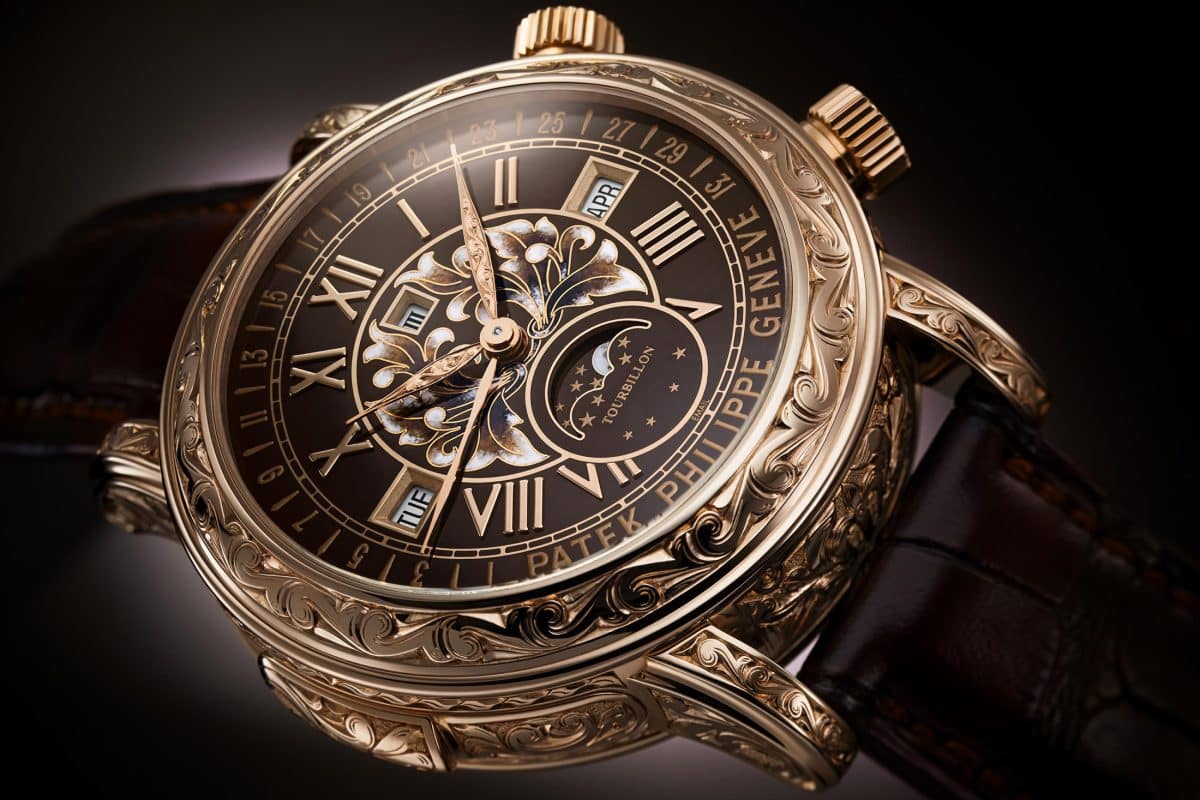
Key Complications at a Glance:
- Minute Repeater: A mechanism that chimes the time on demand. With a slide of a lever, tiny hammers strike tuned gongs to sound out the hours, quarter-hours, and minutes. Patek Philippe is legendary for its repeaters – each is individually tuned to produce a rich, resonant tone.
- Perpetual Calendar: A calendar that automatically accounts for the varying lengths of months and leap years, requiring no date adjustment until the year 2100. Patek Philippe has a long history with perpetual calendars and often pairs them with chronographs or minute repeaters.
- Split-Seconds Chronograph (Rattrapante): A chronograph with an extra seconds hand that can be stopped independently to time multiple events that start together but end at different times. Mechanically, a rattrapante is extremely demanding – requiring perfect synchronization of two chronograph mechanisms in one.
- Tourbillon: A rotating cage for the escapement originally invented to counteract gravity’s effects on pocket watch accuracy. Patek Philippe often hides its tourbillons under solid casebacks – prioritizing precision over display – yet finishes them to the highest standard.
- Celestial Displays: Some grand complications bring the cosmos to the wrist. Patek’s celestial complications display the night sky with rotating star charts, moon phases, and even sidereal time.
How Did Patek Philippe’s Grand Complications Evolve?
To truly appreciate these masterpieces, it’s worth exploring the rich historical journey of Patek Philippe’s grand complications.
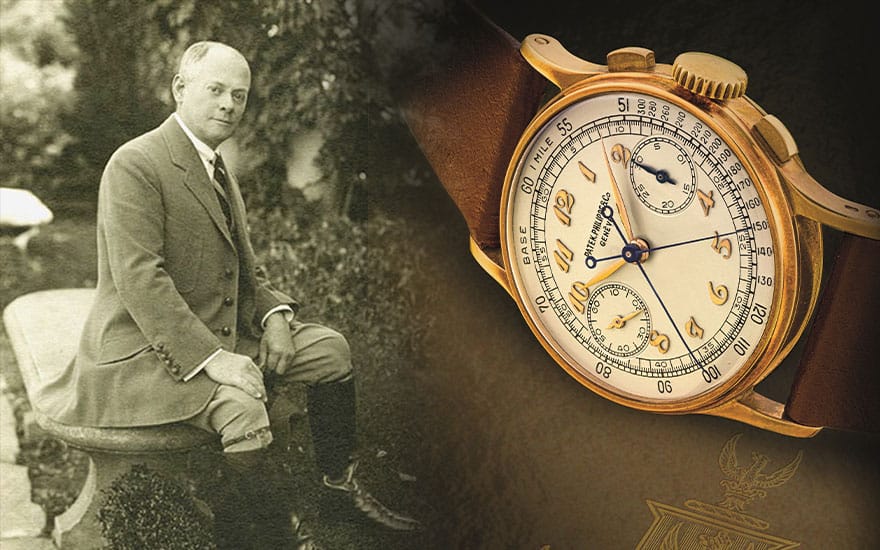
The Packard and Graves Era: In the early 1900s, two American titans – James Ward Packard (automobile magnate) and Henry Graves Jr. (banker) – famously commissioned extraordinarily complicated watches from Patek Philippe. This culminated in The Henry Graves Jr. Supercomplication in 1933, an 18-karat gold pocket watch with 24 complications – ranging from a perpetual calendar to star charts and the times of sunrise and sunset. Decades later, this very watch made history again by fetching $24 million at auction in 2014, underscoring its status as “the most valuable timepiece in auction history”.
The Modern Renaissance: By the 1980s, mechanical watches were experiencing a renaissance. For its 150th anniversary in 1989, Patek unveiled the Calibre 89 – an astounding pocket watch created to reclaim the title of the most complicated watch ever. The Calibre 89 packed 33 complications into a massive watch weighing 1.1 kg and 89mm in diameter.
At this investment level, meticulous verification is non-negotiable. Ensure your high-horology asset is genuine and uncompromised with our expert appraisal team.
Which Patek Philippe Grand Complication Watches Stand Out as Milestones?
Sky Moon Tourbillon Ref. 5002 & 6002 – A Celestial Masterpiece
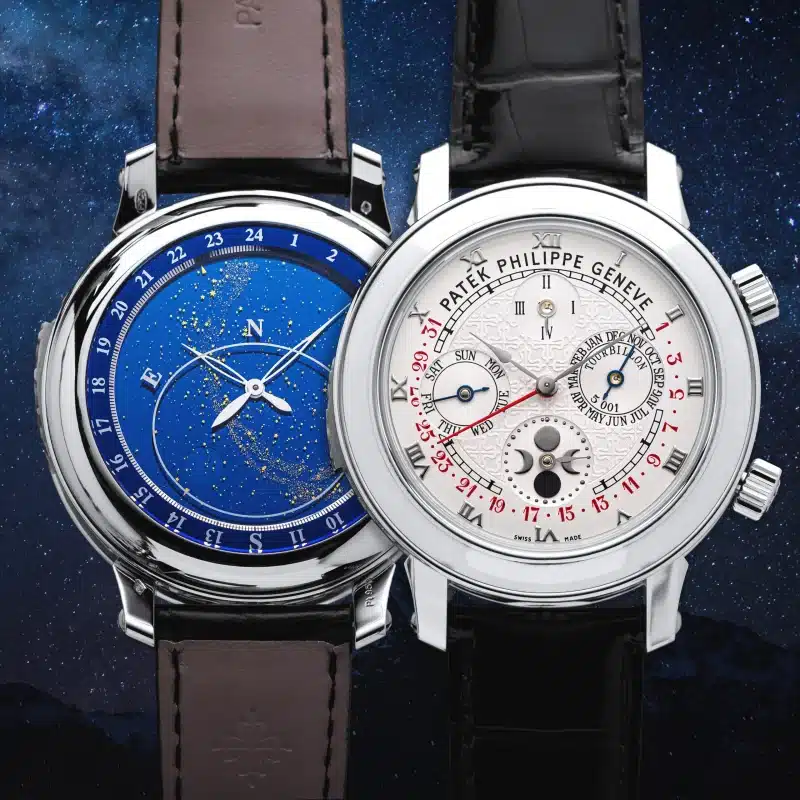
When Patek Philippe released the Sky Moon Tourbillon 5002 in 2001, it was unlike any wristwatch the world had seen. With 12 complications on two dials, the Sky Moon Tourbillon was Patek’s most complicated wristwatch at the time. The front dial presents an array of classic complications: time display, a perpetual calendar with retrograde date, moon phase, and a minute repeater with cathedral gongs.
The back dial is what truly steals hearts: a celestial chart that maps the night sky of the Northern Hemisphere, complete with the motion of the stars and the phase and orbit of the moon. This astronomical display runs on sidereal time and is so precise that the sky chart makes one full rotation per sidereal day (23 hours, 56 minutes) to mirror the real night sky.
Grandmaster Chime Ref. 5175 & 6300 – The Most Complicated Patek Wristwatch
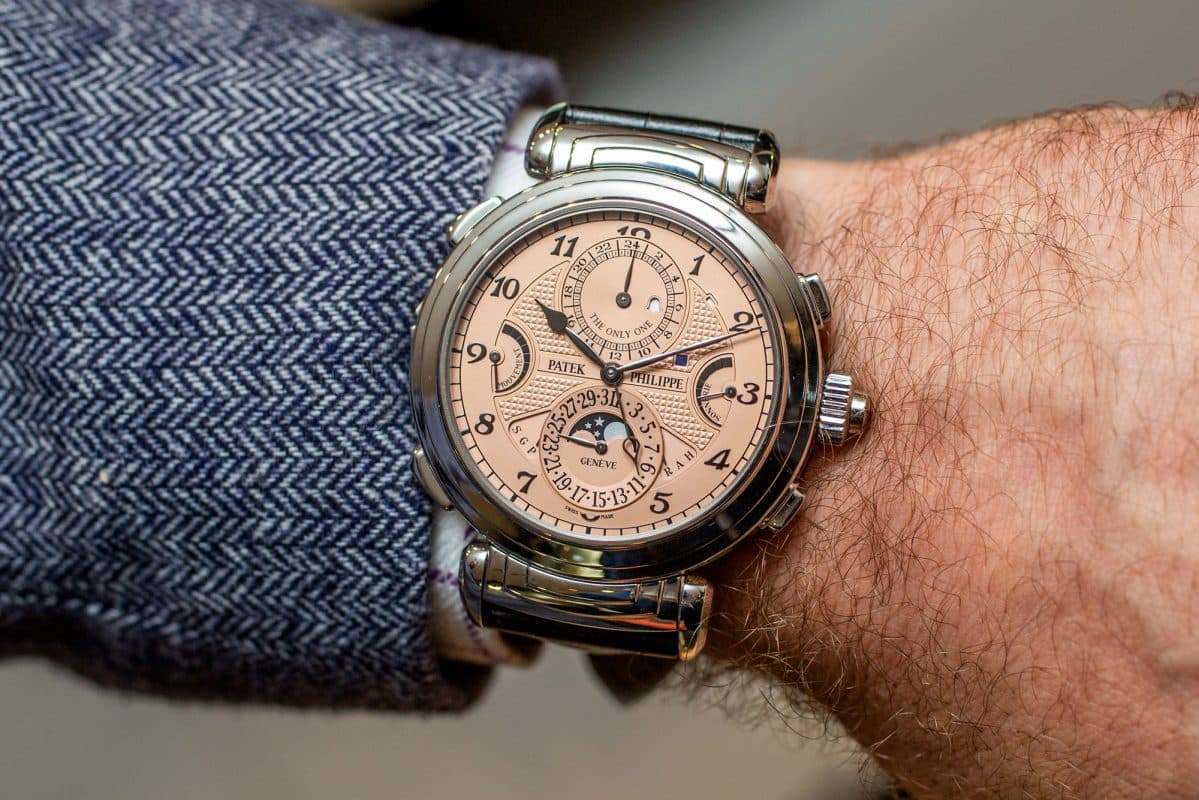
Introduced in 2014 as Ref. 5175R for Patek’s 175th anniversary, the Grandmaster Chime is a 20-complication behemoth. Housed in a massive 47mm reversible case, the Grandmaster Chime packs in five chiming functions: grande sonnerie, petite sonnerie, minute repeater, alarm with time strike, and a date repeater. Among these, the last two were unprecedented world exclusives patented by Patek.
In 2016, Patek introduced Ref. 6300G, which is the non-limited version in white gold. To hold the Grandmaster Chime is to hold one of the most complex machines ever miniaturized. It’s worth noting that a unique stainless steel version of the Grandmaster Chime (Ref. 6300A) was made for charity in 2019 and achieved a hammer price of CHF 31 million, becoming the most expensive wristwatch ever sold at auction.


How Do Artistry and Craftsmanship Elevate These Timepieces?
One defining hallmark of Patek Philippe’s Grand Complications is that they are as much about art as they are about mechanics. The technical complexity might lure you in, but the artisanal decoration is what truly captivates.
Engraving: As we saw with examples like the Sky Moon Tourbillon 6002G and the Grandmaster Chime 5175, hand-engraved cases are a frequent feature on special grand complications. Skilled engravers use small burins to carve intricate patterns into the gold. The work is done under magnification and can take hundreds of hours for a single case.
Enameling: Enamel dials are a cherished Patek Philippe specialty. – Grand Feu enamel: Layering powdered glass and firing it at high temperatures to achieve a smooth, glassy dial surface. – Cloisonné enamel: Used to create pictorial designs by first outlining shapes with thin gold wires and then filling with colored enamels. – Champlevé enamel: Portions of the metal dial are carved out, and the resulting troughs are filled with enamel.
Hand-Finishing (Invisible Art): The true magic occurs where no one can easily look. Even the most deeply hidden bridges are finished with anglage (hand-beveled polished edges), perlage, and Geneva striping. This fanatical dedication to interior perfection is what justifies a Grand Complication’s monumental value.

Acquiring a high-complication timepiece requires dedicated concierge service. Book a secure, one-on-one virtual consultation to source the rarest references on the market.
Frequently Asked Questions
Because they require months or years to construct, production is severely limited. For most buyers without an established, multi-million dollar purchasing history with Patek Philippe, the waitlist is effectively closed or extends beyond a decade. The secondary market is usually the only viable route to ownership without prior allocations.
While models like the Nautilus experience wild, hype-driven market swings, Grand Complications are recognized as ultra-stable, blue-chip investments. Because they are deeply scarce and inherently valuable due to their construction, they provide immense long-term wealth protection and steady appreciation among elite collectors.
While the market shifts frequently, entry-level Grand Complications—such as older pre-owned perpetual calendars—often start around $75,000 to $100,000. As you introduce minute repeaters or tourbillons, the floor price quickly escalates into the high six-figures.
Authentication at this tier goes far beyond visual inspection. It requires a teardown by master watchmakers to inspect the incredibly specific hand-finishing techniques (like specific anglage bevels), verification of the minute repeater tone against Patek’s exact acoustic archives, and rigorous cross-referencing of the serial numbers and Extract from the Archives.
 Free Shipping for all orders