

















Blog, Patek Philippe
Patek Philippe Calatrava: The Ultimate Executive Dress Watch Buying Guide (2026)
Aug
Quick Answer
The Patek Philippe Calatrava is the undisputed gold standard of the classic dress watch. First introduced in 1932, the Calatrava established the minimalist, Bauhaus-inspired design language that continues to define true horological elegance today. Built exclusively from precious metals (gold or platinum) and hand-finished in Geneva, a Calatrava is widely considered the ultimate “quiet luxury” executive timepiece, with entry pricing for vintage examples starting around $14,000 and modern references climbing toward $40,000 to $60,000.
Should You Buy a Patek Philippe Calatrava in 2026?
While the broader global watch market spent the last five years obsessed with stainless steel sports watches like the Patek Philippe Nautilus, true connoisseurs and elite executive buyers have quietly pivoted back to the dress watch.
- Who it is for: The Calatrava is designed for professionals, executives, and collectors ascending to a higher tier of true watchmaking. If you wear a suit or require a discrete, hyper-refined statement piece that slides effortlessly under a tailored cuff, the Calatrava is the pinnacle. It is the definition of “Stealth Wealth”—it doesn’t scream for attention, yet those who know, know.
- Who it is not for: Buyers seeking a daily “beater” watch for swimming, sports, or high-impact activity. (For that, look to an Aquanaut or a Rolex Submariner).
Because the Calatrava never succumbs to short-lived fashion trends, it represents one of the strongest foundational building blocks of a generational watch collection.

The Reality of Buying on the Gray Market
Patek Philippe limits its annual production strictly to preserve quality and exclusivity. While it is certainly easier to acquire a Calatrava at an Authorized Dealer (AD) than a Nautilus, finding specific high-demand references—like the new Reference 6119 with the Clous de Paris bezel—often still requires waitlisting or a prior purchase history.
More importantly, the vast majority of the most celebrated Calatrava models from the last 90 years (like the vintage Ref. 96 or the iconic Ref. 3919) are discontinued. The secondary and gray market is your only portal to sourcing these legendary legacy references.
However, buying a precious metal Patek Philippe requires absolute trust. Our authenticated inventory lets you skip AD wait times for modern pieces and securely acquire verified vintage references. Every timepiece is exhaustively scrutinized—from verifying the Genevan movement finishing to checking the case hallmarks—to ensure your investment is flawless.
Ready to add the cornerstone of "quiet luxury" to your collection? Browse our authenticated inventory of Patek Philippe Calatrava timepieces.
How Did the Calatrava Become the Benchmark?
In 1932, the Great Depression deeply impacted luxury markets. The Stern brothers, having recently acquired Patek Philippe, needed a strategy to save the company from financial peril. Their solution was radical: they moved away from opulent, heavily jeweled pocket watches and introduced a minimalist, time-only wristwatch that adhered to the functionalist Bauhaus design principles.
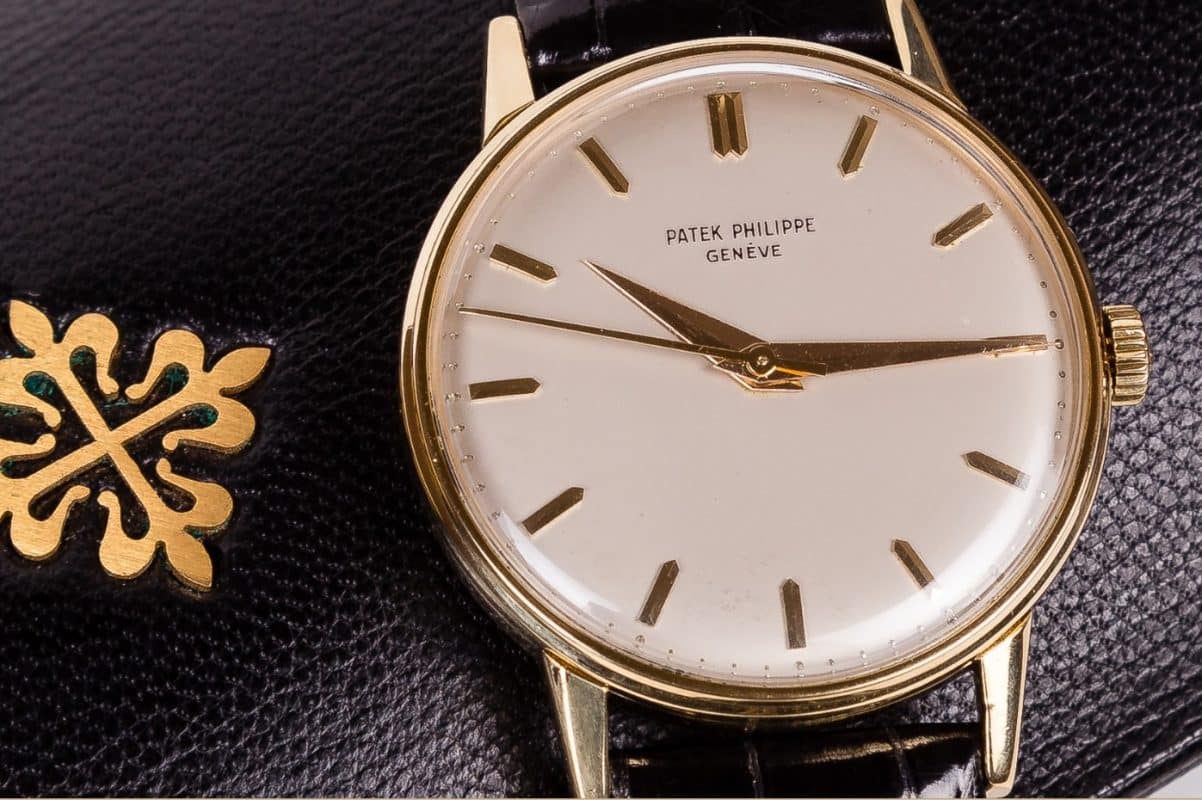
That watch was the Reference 96, the very first Calatrava. Its 31mm case featured perfectly sweeping lugs that seamlessly integrated into a sleek circular bezel, surrounding an ultra-legible dial. Today, that identical design philosophy still dictates how the world defines a “dress watch.”

Movement Mastery & Hand Finishing
Do not let the “simple” exterior fool you. Inside every Calatrava beats a Genevan mechanical engine that takes hundreds of hours to assemble.
Whether it is a manual-wind caliber (the traditionalist’s choice) or a self-winding movement featuring a solid 22k gold micro-rotor, the finishing is spectacular. Patek’s artisans hand-chamfer the bridges (anglage), apply Geneva striping, and precisely balance the delicate Gyromax wheels. Most modern Calatravas feature sapphire crystal exhibition casebacks so you can witness this high-horology art for yourself.

Because dress watches are highly dependent on wrist size, cuff clearance, and formalwear styling, acquiring one requires high-touch consultation. Book a secure, one-on-one virtual alignment to view our Calatrava inventory.
Iconic Calatrava References You Should Know
Reference 3919 (The Modern Classic)
Produced from 1985 until 2006, the Ref. 3919 is arguably the watch that non-enthusiasts picture when they hear the name “Patek Philippe.” Defined by a brilliant white dial, painted Roman numerals, and its signature Clous de Paris (hobnail) bezel—a textured pattern formed by tiny intersecting pyramids—the 3919 became the face of the brand’s legendary “Generations” advertising campaign. It remains an incredibly popular acquisition on the pre-owned market.

Reference 5196 (The Professional’s Choice)
Designed as the direct spiritual successor to the original Ref. 96, the 5196 scales the classic case shape up to a more modern 37mm. With slim applied indices and a subtle small-seconds subdial at 6 o’clock, this model (especially in platinum or white gold) is regarded as the ultimate boardroom power-play watch. It slides frictionlessly under a French cuff.
Reference 6119 (The Contemporary Flagship)
Introduced in 2021, the 6119 perfectly bridges the gap between historical reverence and modern sizing. It revives the beloved Clous de Paris hobnail bezel of the 3919 but stretches the case to 39mm. It also houses Patek’s advanced manual wind Caliber 30-255 PS, which boasts a massive twin-barrel 65-hour power reserve.

Expanding the Dress Watch Boundary: The Pilot Travel Time
While the standard Calatrava is a master of simplicity, Patek has cleverly expanded the collection to include elegant complication models tailored for jet-setting executives. Models like the Calatrava Pilot Travel Time (Ref. 5524G and 5524R) utilize twin time-zone hands inside a vintage aviation format, proving the Calatrava DNA can successfully anchor complex globetrotting instruments.

When investing five figures into vintage or neo-vintage luxury references, ironclad authentication is the difference between a legacy asset and a liability. Ensure your purchase is 100% genuine with our expert appraisal team.
Frequently Asked Questions
Prices vary widely based on age, reference, and material. Entry-level vintage Calatravas (such as well-maintained Reference 96 examples) often start around $14,000 to $18,000. Neo-vintage classics like the 3919 generally range from $18,000 to $25,000. Contemporary references (like the 6119 or 5227) and pieces executed in Platinum frequently command $35,000 to over $60,000.
They serve entirely different purposes within luxury. The Nautilus is a highly visible, casual sports watch integrated with a metal bracelet, originally marketed to yacht owners and athletes. The Calatrava is formal, highly discrete, crafted from precious metals, and worn on a leather strap. The Calatrava represents traditional boardroom subtlety, while the Nautilus represents modern hype and lifestyle signaling.
If you value immediate reliability, modern sizing (39mm+), and modern power reserves, lean toward current production models like the 6119 via our authenticated pre-owned marketplace. However, if you are a purist who appreciates historical proportions (31mm-35mm) and the romance of an artifact, a vintage Calatrava connects you directly to the golden era of Swiss watchmaking.
Historically, the vintage Reference 96 continues to perform exceptionally well due to scarcity and historical value. For modern investments, discontinued milestone models like the 3919 or limited-run anniversary editions boast very strong secondary market stabilization. “Time-only” steel variants (which are exceedingly rare for the Calatrava) also fetch monumental auction results.
 Free Shipping for all orders