

















Blog, Patek Philippe
Patek Philippe Dress & Complication Masterclass: Calatrava, Annual Calendars & Grand Complications
Sep
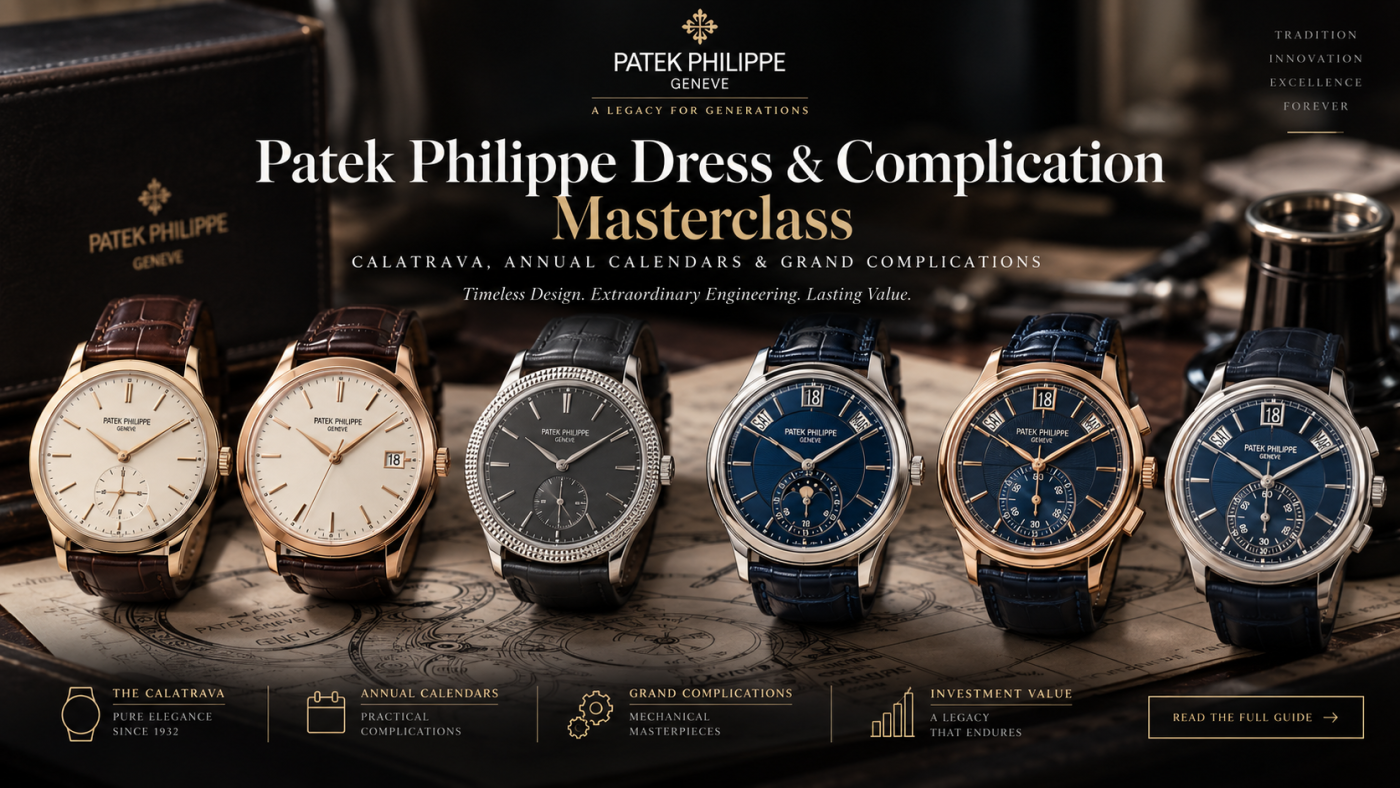
Quick Answer: Patek Philippe Calatrava and Annual Calendar watches combine restrained Geneva design, precious-metal construction and technically important mechanical movements. The Calatrava represents the manufacture’s pure dress-watch tradition, while references such as the 5035, 5205 and 5905 add increasingly sophisticated calendar and chronograph functions without abandoning the elegance that defines Patek Philippe.
The Calatrava Legacy: The Purest Dress Watch Since 1932
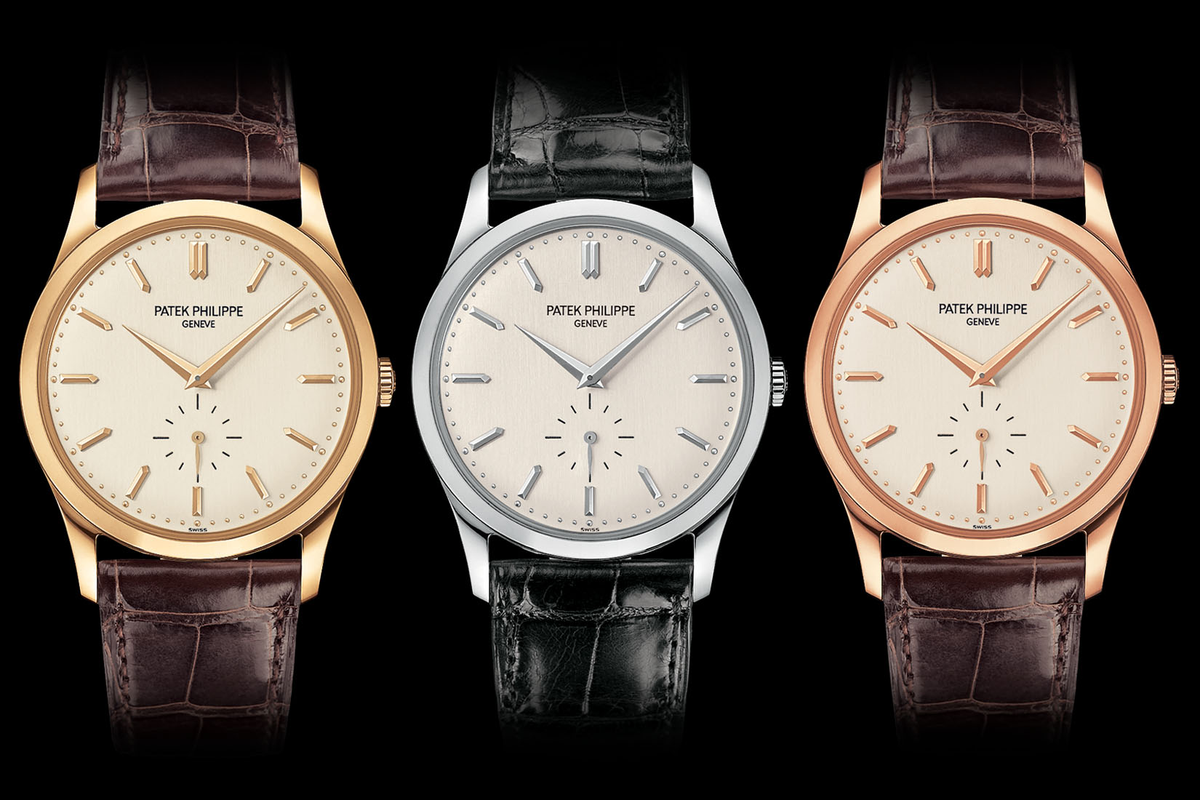
Few watches express traditional Geneva dress-watch design as clearly as the Patek Philippe Calatrava. The collection traces its lineage to Reference 96, introduced in 1932, and has remained closely associated with balanced proportions, restrained dials and cases that avoid decoration for decoration’s sake.
That philosophy is particularly visible in the Calatrava Ref. 5196. At 37mm, the watch feels deliberately classical rather than conventionally modern. The small-seconds display at six o’clock, applied markers, dauphine hands and hand-wound Calibre 215 PS give the 5196 the character of a traditional mechanical dress watch rather than a downsized sports watch disguised by a leather strap.
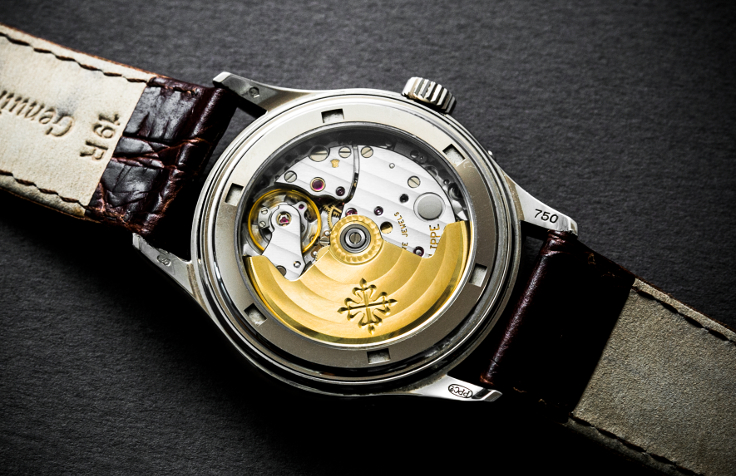
The Ref. 5227 evolves that formula. Its 39mm case is more contemporary, while the automatic Calibre 26-330 S C adds a date aperture and sweep seconds. Patek Philippe also hides a sapphire exhibition back beneath a hinged dust cover. The hinge itself is concealed within the case architecture, which is exactly the sort of unnecessary mechanical elegance collectors expect when paying Patek Philippe money. The yellow-gold 5227J measures 39mm by 9.24mm.
The Ref. 6119G Clous de Paris is more architectural. Its white-gold bezel is decorated with the traditional hobnail, or Clous de Paris, guilloché pattern, surrounding a vertically brushed charcoal dial.
Inside is the manual-winding Calibre 30-255 PS, introduced specifically for the 6119 family. Twin parallel barrels provide at least 65 hours of reserve while the movement remains only 2.55mm thick. The complete 6119G measures 39mm across and just 8.08mm thick.
For a collector, the distinction is straightforward: the 5196 is the pure traditionalist, the 5227 adds practical automatic ownership, and the 6119 turns classical Calatrava design into something more visually assertive without becoming loud.
Patek Philippe Annual Calendars: The Complication of the Century
Patek Philippe introduced its patented Annual Calendar mechanism in 1996, creating a complication positioned neatly between the ordinary date watch and the considerably more complex perpetual calendar. The mechanism recognizes 30- and 31-day months and therefore requires only one manual correction each year, at the end of February. Patek Philippe still describes this once-a-year correction as the defining principle of the complication.
The historically important watch is the Ref. 5035. The yellow-gold 5035J uses a 37mm case and the automatic Calibre 315 S QA 24H. Rather than using the later three-aperture arrangement, the original design organizes calendar information through subdials with a date aperture at six.
It looks unmistakably late-20th-century Patek Philippe: relatively compact, formal and far less aggressive than modern complicated watches.
The Ref. 5205G-013 transforms the annual calendar into a far more contemporary design. Three apertures across the upper half of the dial display the day, date and month, while the moon phase and 24-hour indication sit at six.
The white-gold case measures 40mm, and the blue sunburst dial darkens toward its outer edge. Inside is the self-winding Calibre 26-330 S QA LU 24H, comprising 339 parts.
This aperture architecture is particularly effective because a complicated watch can be read almost instantly. There is no need to mentally decode several overlapping subdials.
The Ref. 5905 pushes the idea much further by combining the Annual Calendar with a flyback chronograph. The current rose-gold 5905R-010 uses the Calibre CH 28-520 QA 24H, displaying day, date and month across the upper dial and a 60-minute chronograph counter at six.
The result is one of the clearest examples of how Patek Philippe builds complexity hierarchically: Calatrava at the pure end, Annual Calendar in the middle and increasingly elaborate chronograph, perpetual-calendar and repeating mechanisms above it.
Precious Metals & Hallmarks: Yellow Gold, Rose Gold, White Gold & Platinum
Precious metal changes much more than the color of a Patek Philippe.
Yellow gold gives the 5196J, 5227J and early 5035J the most traditional Geneva appearance. Rose gold softens the formality and works especially well with warm silver, brown or blue dials. White gold gives the visual discretion of steel while retaining the weight and value of an 18K precious-metal case.
The 6119R is an excellent example. The Clous de Paris bezel becomes markedly warmer and more decorative in rose gold than in the almost monochromatic 6119G.
Platinum sits at the opposite end of the spectrum. The discontinued 5905P-001 combines a 42mm platinum case with a blue dial, Annual Calendar and flyback chronograph.
Platinum cases usually feel noticeably denser on the wrist than comparable gold watches. For collectors examining a pre-owned example, case condition can therefore matter almost as much as reference number.
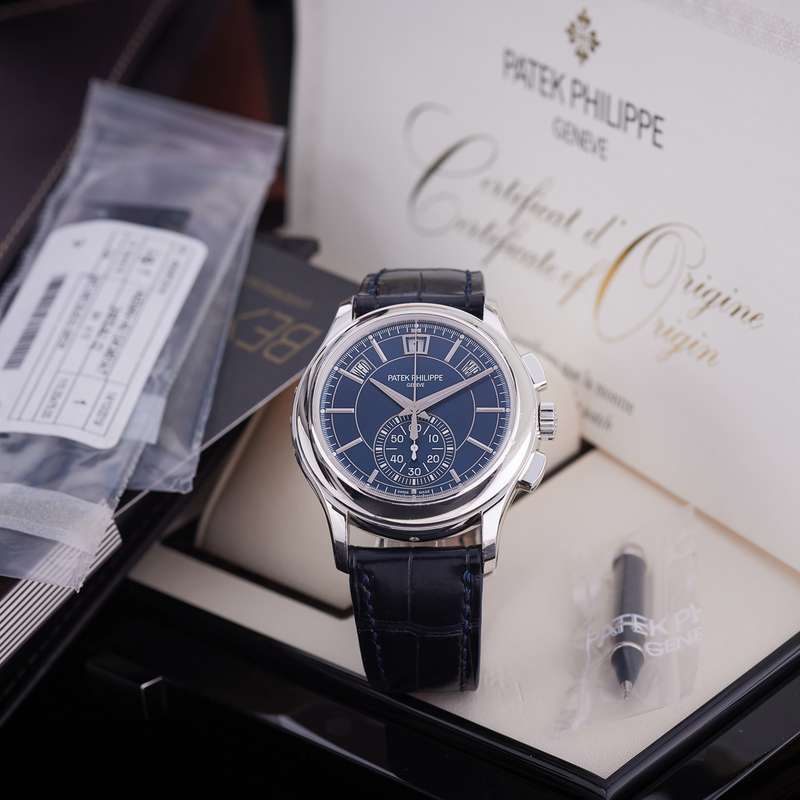
Repeated polishing can soften the profile of lugs, bezel transitions and hallmarks. Sharp geometry, legible stamps and original finishing are all worth inspecting carefully.
Box, papers and service documentation also matter, particularly at the higher end of the market. They do not guarantee future appreciation. Watches are mechanical objects, not magically compounding bearer bonds with straps attached. But completeness can improve desirability, resale confidence and liquidity.
Specification & Secondary Market Pricing Matrix
Secondary-market prices vary with condition, production year, dial configuration, service history, provenance and whether the watch retains its original box and papers. The following figures are best treated as September 2026 market reference points, not guaranteed transaction prices.
| Reference | Collection / Complication | Case | Size | Movement | Approx. Sept. 2026 Market Level |
|---|---|---|---|---|---|
| 5196J | Calatrava, small seconds | 18K yellow gold | 37mm | Manual Cal. 215 PS | $21,824 |
| 5227J | Calatrava, date | 18K yellow gold | 39mm | Automatic 26-330 S C | $29,460 |
| 6119G | Calatrava Clous de Paris | 18K white gold | 39mm | Manual 30-255 PS | $27,842 |
| 6119R | Calatrava Clous de Paris | 18K rose gold | 39mm | Manual 30-255 PS | $28,965 |
| 5035J | Annual Calendar | 18K yellow gold | 37mm | Automatic 315 S QA 24H | $22,372 |
| 5205G | Annual Calendar Moon Phase | 18K white gold | 40mm | Automatic 26-330 S QA LU 24H | $43,050 |
| 5905P | Annual Calendar Flyback Chronograph | Platinum | 42mm | Automatic CH 28-520 QA 24H | about $59,500 |
WatchCharts estimated the 5196J at $21,824, the 5227J at $29,460, the 6119G at roughly $27,800 and the 6119R at roughly $29,000 in September 2026.
For Annual Calendars, WatchCharts listed the 5035J at about $22,372, the 5205G family around $43,050 and the platinum 5905P around $59,500.
The useful lesson is that complexity and original retail price do not translate mechanically into resale performance. Reference desirability, dial, metal, production status and collector demand all matter.
5 Frequently Asked Questions for Patek Philippe Collectors
1. Is a Patek Philippe Calatrava a good first Patek?
For buyers interested in traditional watchmaking rather than sports-watch hype, it can be one of the most logical entry points. References such as the 5196 and 5227 provide recognizable Patek Philippe design and precious-metal construction without Nautilus or Aquanaut pricing.
2. What is the difference between an Annual Calendar and a perpetual calendar?
An Annual Calendar automatically recognizes 30- and 31-day months but requires correction after February. A perpetual calendar accounts for February and leap years as well, assuming the watch remains correctly set and running.
3. Why is Ref. 5035 historically important?
It introduced Patek Philippe’s patented Annual Calendar wristwatch in 1996, creating an entirely new practical complication category that remains central to the brand today.
4. Is the 6119 more collectible than the 5196?
They appeal to slightly different collectors. The 5196 offers traditional proportions and a historically familiar Calatrava aesthetic. The 6119 provides the Clous de Paris bezel, larger 39mm proportions and the newer 65-hour Calibre 30-255 PS.
5. What should buyers inspect on a pre-owned Patek Philippe?
Check reference and serial information, case geometry, hallmarks, dial condition, movement condition, service history, correct components and provenance. On polished precious-metal examples, softened lugs and weakened hallmarks deserve particular attention.
Acquire Certified Pre-Owned Patek Philippe Watches at Luxury Watches USA
The strongest Patek Philippe purchase is rarely determined by reference number alone. Condition, configuration, provenance and price relative to the current secondary market all deserve equal attention.
Luxury Watches USA currently lists hundreds of Patek Philippe watches across Calatrava, Complications, Nautilus, Aquanaut and other families. The main Patek Philippe category currently contains more than 600 listings, including more than 70 Calatrava watches.
For buyers seeking understated formal watches, the Calatrava remains the natural starting point. Those wanting additional mechanical substance can move toward the Annual Calendar and chronograph references without immediately entering the far more expensive world of minute repeaters and top-tier Grand Complications.
Shop Patek Philippe Watches at Luxury Watches USA
Explore Patek Philippe Calatrava Watches
Whether the target is a manually wound 5196, a modern Clous de Paris 6119 or a platinum 5905 Annual Calendar Chronograph, the sensible collector strategy remains remarkably unglamorous: buy the best-condition example you can verify, understand where its price sits in the current market, and prioritize originality over a suspiciously shiny case. Humanity has already polished enough vintage watches into soap bars.
 Free Shipping for all orders