

















Blog
Annual Calendar vs. Perpetual Calendar: What’s the Real Difference?
Dec
The Gregorian calendar is a masterpiece of historical compromise, featuring months of inconsistent lengths and the elusive leap year every four years. For watchmakers, this creates a significant engineering hurdle. While a standard date watch requires manual adjustment four times a year, the industry’s most prestigious complications—the Annual Calendar and the Perpetual Calendar—were designed to solve this inconvenience entirely.
Choosing between these two mechanical marvels requires an understanding of their internal “memory.” One offers an intelligent, modern compromise, while the other represents the absolute zenith of traditional horological calculation.
Executive Summary
- Annual Calendar (AC): Automatically differentiates between 30 and 31-day months. Requires exactly one manual adjustment per year—on March 1st.
- Perpetual Calendar (QP): A “mechanical brain” that accounts for 28, 30, and 31-day months, plus the 29-day February in leap years. Requires no adjustment until the year 2100.
- Historical Origin: The Annual Calendar was famously invented by Patek Philippe in 1996 (Ref. 5035), making it a relatively young complication in the world of high horology.
- Investment & Maintenance: Annual calendars offer roughly 95% of the convenience of a perpetual at a significantly lower entry price and reduced long-term service costs.
What is an Annual Calendar?
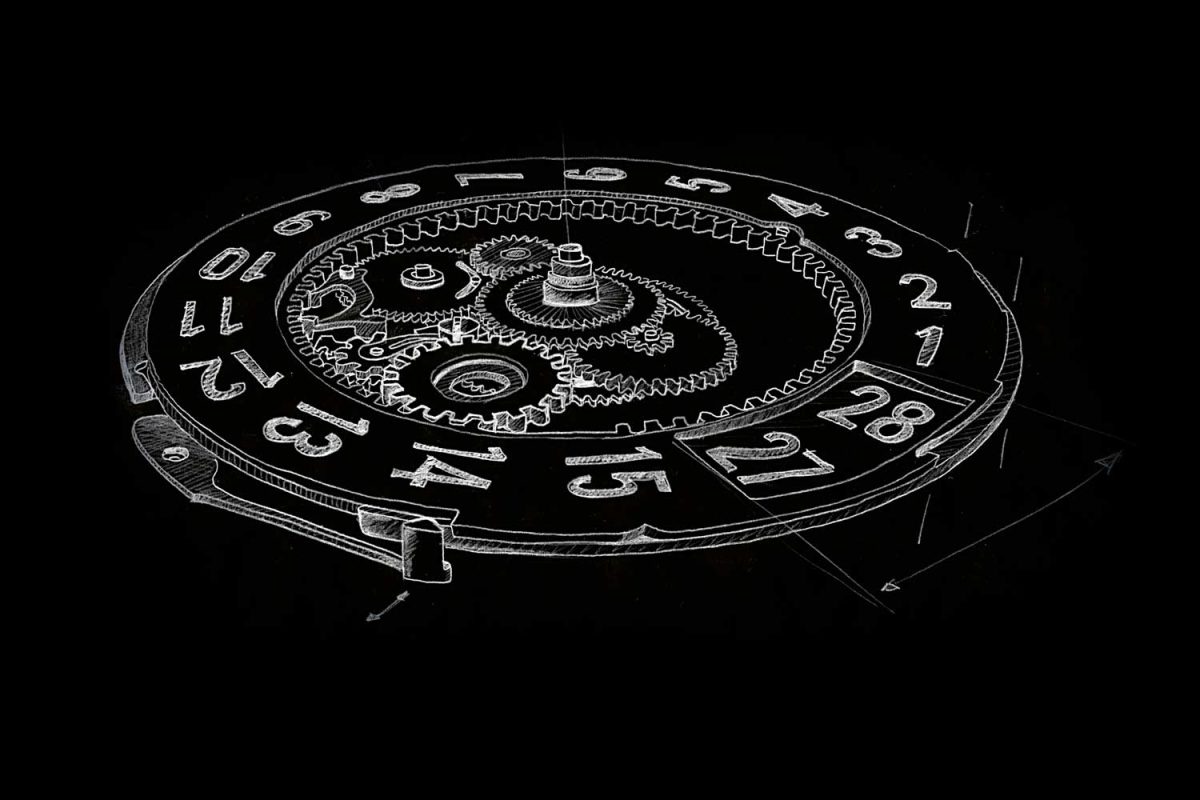
The Annual Calendar is a sophisticated mechanism that accurately recognizes which months have 30 days (April, June, September, and November) and which have 31. It uses a series of wheels and pinions to “know” when to advance the date double-time past the 31st.
The one exception is February. Because the Annual Calendar does not track the four-year leap year cycle, it treats February as a standard month. On March 1st, regardless of whether it is a leap year, the owner must manually advance the date to realign the watch with the calendar year.

Looking to enter the world of high complications? Explore our selection of fully authenticated Annual Calendar timepieces from Patek Philippe and Rolex.
What is a Perpetual Calendar?
Known in French as the Quantième Perpétuel, the Perpetual Calendar is a mechanical computer. It features a memory of 1,461 days—exactly four years—allowing it to automatically account for the 29th of February every four years.
This complication is far more complex than the annual calendar, often requiring hundreds of additional components to manage the leap year cycle. It is a statement piece for the purist who values mechanical “perfection” and historical prestige.
The Year 2100 Boundary
Most mechanical perpetual calendars are accurate until the year 2100. According to the Gregorian calendar, 2100 is a secular year—not a leap year. Because mechanical movements cannot typically track the 400-year cycle required to account for this exception, a manual adjustment will be needed on March 1st of that year.

Ready to upgrade to a Grand Complication? Secure a market-leading cash offer for your current collection from our senior Diamond District buyers.
The Rolex Sky-Dweller: The Ultimate Annual Calendar
Rolex approached the calendar problem with typical engineering elegance. The Sky-Dweller uses the patented “SAROS” system, which achieves annual calendar functionality using only four additional parts. It displays the month via small apertures above the hour markers—a brilliant solution that keeps the dial clean while providing highly practical utility.
Practicality vs. Prestige
While the Perpetual Calendar is the more prestigious complication, many collectors consider the Annual Calendar the “smarter” daily wearer.
- Winder Anxiety: If a Perpetual Calendar stops, resetting the date, month, year, and leap year cycle can be a complex task that often requires a professional watchmaker’s touch.
- Service Costs: A Perpetual Calendar typically commands twice the service costs of an Annual Calendar due to the extreme complexity of its calendar module.
- Durability: Annual calendars, being less reliant on delicate cams and levers, are generally more robust for long-term daily use.

Unsure which high complication aligns with your collection goals? Book a confidential video consultation with our Diamond District senior experts today.
Frequently Asked Questions
Patek Philippe invented the annual calendar in 1996 with the Reference 5035. Unlike the perpetual calendar, which has been around for centuries, the annual calendar is a modern horological innovation.
Because the year 2100 is not a leap year, your watch will advance to February 29th incorrectly. You will need to manually move the date forward by one day on March 1st to realign the mechanism.
The Rolex Sky-Dweller is an annual calendar. It utilizes the Saros system to track 30 and 31-day months, but it does require a manual adjustment at the end of February each year.
Perpetual calendars are significantly more complex, containing many more parts that must be perfectly synchronized. Servicing them requires more hours of labor from master watchmakers and a higher degree of technical risk during the reassembly of the calendar module.
 Free Shipping for all orders